
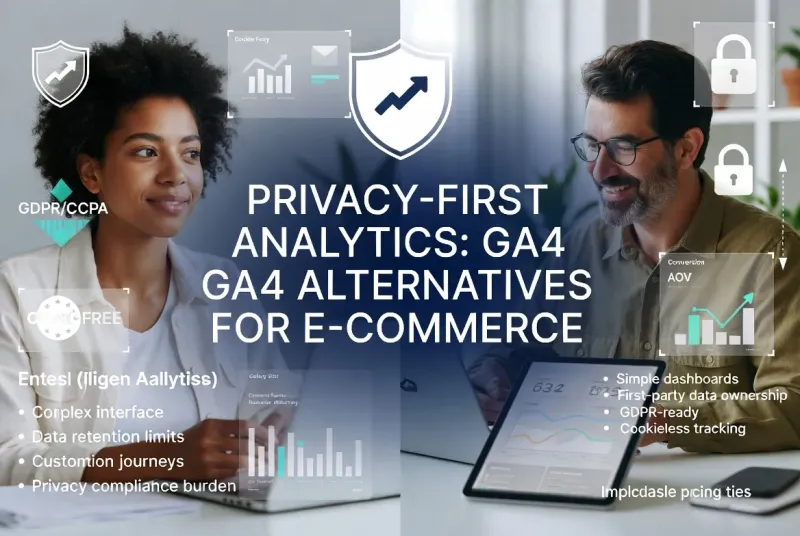
As we navigate through 2026, the analytics landscape for small e-commerce businesses has fundamentally shifted. With increasing privacy regulations, growing consumer awareness about data protection, and the phase-out of third-party cookies, small e-commerce shop owners are actively seeking alternatives to Google Analytics 4 (GA4) that respect user privacy while still providing actionable insights.
The transition away from GA4 isn't just about compliance—it's about building trust with your customers. Modern consumers are increasingly privacy-conscious, with 86% of online shoppers concerned about their data privacy and 79% more likely to purchase from brands they trust with their data. For small e-commerce businesses, adopting privacy-first analytics isn't just an ethical choice; it's a competitive advantage that can differentiate your brand and build customer loyalty.
This comprehensive guide explores the best privacy-first analytics alternatives to GA4 specifically tailored for small e-commerce shops in 2026. We'll examine tools that prioritize user privacy, comply with GDPR and other privacy regulations, provide essential e-commerce tracking without invasive cookies, and remain affordable and easy to implement for small businesses. Whether you're looking to completely replace GA4 or supplement it with privacy-focused tools, you'll find practical recommendations, detailed comparisons, and implementation guidance to make an informed decision for your online store.
Why Small E-commerce Shops Need Privacy-First Analytics in 2026
The analytics landscape has undergone dramatic changes, making privacy-first solutions not just preferable but essential for small e-commerce businesses.
The Privacy Regulation Landscape
By 2026, privacy regulations have become more stringent and widespread:
- GDPR (General Data Protection Regulation): Continues to set the global standard with fines up to €20 million or 4% of annual global turnover
- CCPA/CPRA (California Consumer Privacy Act/Privacy Rights Act): Grants California residents extensive data rights
- ePrivacy Directive: Requires explicit consent for non-essential cookies
- Emerging Regulations: New privacy laws in Virginia, Colorado, Connecticut, and other states create a complex compliance landscape
For small e-commerce businesses, navigating this complex regulatory environment with traditional analytics tools like GA4 can be challenging and risky. Privacy-first analytics solutions are designed to be compliant by default, reducing legal risk and administrative burden.
Consumer Trust and Brand Reputation
Modern consumers are voting with their wallets:
- 86% of consumers say data privacy is a growing concern
- 79% are more likely to purchase from brands they trust with their data
- 68% have stopped using a service due to privacy concerns
- 72% say they would pay more for products from privacy-respecting companies
For small e-commerce shops, demonstrating respect for customer privacy isn't just ethical—it's a powerful differentiator that can drive customer acquisition and retention.
Technical Advantages of Privacy-First Analytics
Beyond compliance and trust, privacy-first analytics offer practical benefits:
- Faster Load Times: Lightweight scripts (often 10-50x smaller than GA4) improve page load speeds, directly impacting conversion rates
- No Cookie Banners: Many privacy-first tools don't require cookie consent banners, improving user experience
- Better Data Accuracy: No ad blockers blocking your analytics, leading to more accurate data
- Simpler Implementation: Easier to set up and maintain than complex GA4 configurations
- Lower Costs: Often more affordable than GA4 360 or enterprise analytics solutions
Essential Features for E-commerce Analytics
When evaluating privacy-first analytics alternatives, small e-commerce shops need specific features to track business performance effectively.
Must-Have E-commerce Tracking Features
Core E-commerce Metrics:
- Conversion Rate: Track percentage of visitors who make a purchase
- Revenue Tracking: Monitor total sales, average order value (AOV)
- Product Performance: Track which products are viewed, added to cart, and purchased
- Cart Abandonment: Identify where customers drop off in the checkout process
- Traffic Sources: Understand where your customers come from (organic, paid, social, direct)
- Customer Journey: Track user paths through your store
Privacy-Compliant Implementation:
- No personal data collection (no IP addresses, no user identifiers)
- Aggregate data only (no individual user tracking)
- Cookieless tracking or first-party cookies only
- Data anonymization by default
- Servers located in privacy-friendly jurisdictions (EU, etc.)
Nice-to-Have Advanced Features
- Goal Funnels: Visualize conversion funnels for key actions
- Event Tracking: Track specific actions (newsletter signups, video views, file downloads)
- Custom Dimensions: Track custom data points relevant to your business
- Real-time Analytics: See current visitor activity
- API Access: Integrate with other tools and create custom reports
- Data Export: Export data for deeper analysis or backup
Top Privacy-First Analytics Alternatives for Small E-commerce in 2026
After extensive research and testing, these platforms stand out as the best privacy-first analytics alternatives for small e-commerce shops in 2026.
1. Plausible Analytics: Best Overall for Small E-commerce
Overview: Plausible Analytics has emerged as the leading privacy-first analytics platform, offering a perfect balance of simplicity, privacy, and e-commerce functionality. It's lightweight (45x smaller than GA4), open-source, and designed specifically as a GA4 alternative.
Key Features:
- Privacy-First by Design: No cookies, no personal data collection, fully GDPR/CCPA compliant
- E-commerce Tracking: Built-in e-commerce events (product views, add to cart, purchases)
- Goal Tracking: Set up custom goals for key conversions
- Revenue Tracking: Track revenue and conversion values
- Lightweight: 1 KB script that doesn't slow down your site
- Simple Dashboard: Clean, intuitive interface focused on essential metrics
- No Cookie Banner Needed: Compliant without annoying visitors
E-commerce Specific Features:
- Product page view tracking
- Add to cart event tracking
- Checkout initiation tracking
- Purchase completion with revenue tracking
- Traffic source attribution for sales
- Custom event tracking for any e-commerce action
Pricing:
- Starter: $9/month (up to 10K pageviews)
- Business: $29/month (up to 50K pageviews)
- Growth: $69/month (up to 200K pageviews)
- Self-hosted: Free (open-source, host yourself)
Best For: Small to medium e-commerce shops wanting a simple, privacy-compliant solution that's easy to implement and doesn't require cookie banners.
Pros:
- Extremely easy to set up (5 minutes)
- No cookie consent required
- Lightweight and fast
- Transparent, open-source
- Excellent e-commerce tracking
- Great customer support
Cons:
- Limited advanced segmentation
- No user-level tracking (by design)
- Less customizable than GA4
2. Fathom Analytics: Best for Simplicity and Compliance
Overview: Fathom Analytics is a privacy-focused analytics platform that prioritizes simplicity and compliance. It's designed to be a direct GA4 replacement with a focus on essential metrics and privacy.
Key Features:
- Privacy-First: GDPR, CCPA, and PECR compliant
- No Cookies: Uses first-party cookies only when necessary
- Simple Interface: Clean dashboard showing only essential metrics
- E-commerce Events: Track purchases, revenue, and conversions
- Goal Tracking: Set up conversion goals
- Fast & Lightweight: 5x faster than GA4
E-commerce Specific Features:
- Revenue tracking
- Conversion tracking
- Product performance metrics
- Traffic source attribution
- Custom event tracking
- Funnel visualization
Pricing:
- Starter: $14/month (up to 10K pageviews)
- Plus: $34/month (up to 50K pageviews)
- Pro: $94/month (up to 200K pageviews)
- Self-hosted: Available (one-time fee)
Best For: E-commerce shops that prioritize simplicity and want a straightforward, compliant analytics solution without complexity.
Pros:
- Extremely simple to use
- No cookie banners needed
- Fast implementation
- Strong privacy compliance
- Good e-commerce tracking
- Excellent uptime and reliability
Cons:
- Limited advanced features
- Less customization options
- Higher price point than some alternatives
3. Simple Analytics: Best for Privacy Purists
Overview: Simple Analytics lives up to its name by providing the simplest, most privacy-focused analytics solution. It's designed for businesses that want essential insights without any privacy compromises.
Key Features:
- 100% Privacy-First: No cookies, no tracking, no personal data
- GDPR Compliant: Fully compliant without cookie banners
- Simple Dashboard: Only shows essential metrics
- E-commerce Events: Basic e-commerce tracking
- Email Reports: Automated reports sent to your inbox
- Public Dashboards: Share analytics publicly if desired
E-commerce Specific Features:
- Pageview tracking for product pages
- Event tracking for key actions
- Referrer tracking
- Basic conversion tracking
- Custom event support
Pricing:
- Starter: $19/month (up to 100K events)
- Business: $49/month (up to 500K events)
- Enterprise: Custom pricing
Best For: E-commerce businesses that prioritize privacy above all else and want the simplest possible solution.
Pros:
- Maximum privacy protection
- No cookie consent needed
- Extremely simple interface
- Open-source and transparent
- Great for privacy-focused brands
Cons:
- Limited e-commerce features
- Less detailed analytics
- Higher price for basic features
- Smaller feature set
4. Umami: Best Self-Hosted Option
Overview: Umami is an open-source, self-hosted analytics platform that gives you complete control over your data while maintaining privacy compliance. It's ideal for technically-savvy e-commerce shop owners who want full data ownership.
Key Features:
- Self-Hosted: Complete control over your data
- Open-Source: Transparent codebase (MIT license)
- Privacy-First: No cookies, no personal data collection
- Lightweight: Fast-loading script
- Customizable: Modify to fit your needs
- E-commerce Tracking: Custom event tracking
E-commerce Specific Features:
- Custom event tracking for e-commerce actions
- Goal tracking
- Traffic source tracking
- Page view tracking
- Custom data collection via API
Pricing:
- Self-Hosted: Free (open-source)
- Cloud-Hosted: Starting at $9/month
- Hosting Costs: Varies by provider (typically $5-20/month)
Best For: Technically-savvy e-commerce shop owners who want complete data control and are comfortable with self-hosting.
Pros:
- Complete data ownership
- No ongoing subscription costs (self-hosted)
- Fully customizable
- Privacy-compliant by default
- Active community and development
Cons:
- Requires technical knowledge to set up
- You're responsible for maintenance and updates
- Less polished than commercial solutions
- Limited support compared to paid services
5. PostHog: Best for Product Analytics + Privacy
Overview: PostHog is a comprehensive product analytics platform that combines privacy-first analytics with feature flags, session recording, and A/B testing. It's ideal for e-commerce shops wanting advanced product analytics while maintaining privacy.
Key Features:
- Product Analytics: Deep insights into user behavior
- Privacy-First: GDPR compliant, privacy-focused
- Session Recording: See how users interact with your store (privacy-compliant)
- Feature Flags: Test new features safely
- A/B Testing: Optimize conversions
- Self-Hosted or Cloud: Choose your deployment
E-commerce Specific Features:
- Advanced funnel analysis
- Cohort analysis
- User paths and journeys
- Product analytics
- Custom event tracking
- Revenue tracking
Pricing:
- Free Tier: Up to 1M events/month
- Pro: $0.00045 per event (after free tier)
- Enterprise: Custom pricing
- Self-Hosted: Free (open-source)
Best For: Growing e-commerce shops that want advanced product analytics, A/B testing, and feature flags while maintaining privacy compliance.
Pros:
- Comprehensive feature set
- Generous free tier
- Open-source option
- Advanced analytics capabilities
- Strong privacy features
Cons:
- Can be complex for simple needs
- Steeper learning curve
- May be overkill for very small shops
6. Matomo (formerly Piwik): Best GA4 Feature Parity
Overview: Matomo is the most feature-rich privacy-first analytics platform, offering the closest feature parity to GA4 while maintaining privacy compliance. It's ideal for shops that need comprehensive analytics without compromising privacy.
Key Features:
- Full-Featured: Comprehensive analytics suite
- Privacy-First: GDPR compliant, anonymization options
- E-commerce Analytics: Advanced e-commerce tracking
- Self-Hosted or Cloud: Flexible deployment
- Customizable: Extensive customization options
- Data Ownership: You own your data
E-commerce Specific Features:
- Advanced e-commerce tracking
- Product performance analytics
- Shopping cart analysis
- Revenue tracking
- Category performance
- Custom dimensions and variables
Pricing:
- Cloud: Starting at $23/month (up to 50K pageviews)
- On-Premises: Starting at $99/month
- Self-Hosted: Free (open-source)
Best For: E-commerce shops that need comprehensive analytics features similar to GA4 but with privacy compliance and data ownership.
Pros:
- Most feature-rich privacy-first option
- Closest to GA4 in functionality
- Open-source option available
- Strong e-commerce features
- Data ownership
Cons:
- Can be complex to set up
- Heavier than simpler alternatives
- May require more technical knowledge
Comparison Table: Quick Overview
| Platform | Best For | Starting Price | E-commerce Features | Self-Hosted | Cookie Consent |
|---|---|---|---|---|---|
| Plausible Analytics | Overall best | $9/month | Excellent | Yes | No |
| Fathom Analytics | Simplicity | $14/month | Good | Yes | No |
| Simple Analytics | Privacy purists | $19/month | Basic | No | No |
| Umami | Data control | Free (self-hosted) | Good | Yes | No |
| PostHog | Advanced analytics | Free tier | Excellent | Yes | Optional |
| Matomo | GA4 alternative | $23/month | Excellent | Yes | Optional |
Implementation Guide: Migrating from GA4 to Privacy-First Analytics
Switching from GA4 to a privacy-first analytics platform doesn't have to be complicated. Follow this step-by-step guide for a smooth transition.
Step 1: Audit Your Current GA4 Setup
Before migrating, document what you're currently tracking:
- List all events you're tracking (pageviews, purchases, add to cart, etc.)
- Identify key goals and conversions
- Document custom dimensions and metrics
- Note any integrations (Google Ads, Search Console, etc.)
- Export historical data you want to keep
Step 2: Choose Your Privacy-First Platform
Based on your needs, budget, and technical capabilities, select the best platform from our recommendations above. Consider:
- Your monthly pageview volume
- Required e-commerce features
- Technical expertise (self-hosted vs. cloud)
- Budget constraints
- Privacy compliance requirements
Step 3: Set Up Your New Analytics
For Cloud-Hosted Solutions:
- Create an account with your chosen platform
- Add your website/domain
- Copy the tracking script
- Install the script on your e-commerce platform
Installation by Platform:
- Shopify: Add tracking code to theme.liquid or use app integration
- WooCommerce: Add to header.php or use plugin
- BigCommerce: Add to Storefront > Script Manager
- Custom: Add to section of all pages
Step 4: Configure E-commerce Tracking
Set up e-commerce specific tracking:
- Product Views: Track when products are viewed
- Add to Cart: Track add to cart events
- Checkout: Track checkout initiation
- Purchases: Track completed purchases with revenue
- Custom Events: Track any other important actions
Most privacy-first platforms provide simple JavaScript event tracking. Example:
// Example: Track purchase
plausible('Purchase', {
  props: {
    revenue: 99.99,
    currency: 'USD',
    products: ['Product A', 'Product B']
  }
});
Step 5: Test Your Implementation
Before going live:
- Use browser developer tools to verify tracking script loads
- Test key events (pageviews, purchases, etc.)
- Verify data appears in your analytics dashboard
- Check that no personal data is being collected
- Test on multiple devices and browsers
Step 6: Run Parallel Tracking (Optional but Recommended)
For the first 30-60 days, run both GA4 and your new privacy-first analytics in parallel to:
- Compare data accuracy
- Ensure no data gaps
- Validate e-commerce tracking
- Build confidence in the new system
Step 7: Remove GA4 and Update Privacy Policy
Once confident in your new setup:
- Remove GA4 tracking code from your site
- Update your privacy policy to reflect new analytics
- Remove cookie consent for analytics (if applicable)
- Inform stakeholders of the change
E-commerce Platform-Specific Integration
Shopify Integration
Method 1: Manual Installation
- Go to Online Store > Themes
- Click "Actions" > "Edit code"
- Open theme.liquid
- Paste tracking script before
- Save and test
Method 2: App Integration
- Plausible: Use official Shopify app
- Fathom: Use third-party integration app
- Matomo: Use Matomo Tracker app
E-commerce Events: Most platforms offer Shopify-specific event tracking for purchases, add to cart, and product views.
WooCommerce Integration
Method 1: Plugin
- Plausible Analytics for WordPress plugin
- Matomo Analytics plugin
- Custom code via functions.php
Method 2: Manual
- Add tracking script to header.php
- Use WooCommerce hooks for e-commerce events
- Example:
add_action('woocommerce_thankyou', 'track_purchase');
function track_purchase($order_id) {
    $order = wc_get_order($order_id);
    // Send purchase event to analytics
}
BigCommerce Integration
- Go to Storefront > Script Manager
- Add new script
- Paste tracking code
- Set to load on all pages
- Use BigCommerce events for e-commerce tracking
Measuring Success: Key Metrics to Track
After migrating, focus on these essential e-commerce metrics:
Core E-commerce Metrics
- Conversion Rate: Percentage of visitors who purchase
- Average Order Value (AOV): Average revenue per order
- Revenue: Total sales revenue
- Traffic Sources: Where customers come from
- Product Performance: Which products sell best
- Cart Abandonment Rate: Percentage who abandon cart
Privacy-First Metrics
- Pageviews: Total page views (no personal data)
- Bounce Rate: Percentage who leave after one page
- Session Duration: Average time on site
- Goal Completions: Custom goal achievements
Frequently Asked Questions
Will I lose historical data when switching from GA4?
You won't automatically transfer historical GA4 data to privacy-first platforms, but you can:
- Export GA4 data before removing it (Google allows data export)
- Keep GA4 access in read-only mode for historical analysis
- Use both systems in parallel during transition
- Focus on forward-looking analytics with your new platform
Most privacy-first platforms don't import historical data by design, as they prioritize privacy from day one.
Can privacy-first analytics track e-commerce conversions as well as GA4?
Yes, modern privacy-first analytics platforms can track all essential e-commerce conversions:
- Purchases and revenue
- Add to cart events
- Product views
- Checkout initiation
- Custom conversion events
While they may lack some of GA4's advanced machine learning features, they provide all the essential data small e-commerce shops need to make informed decisions.
Do privacy-first analytics work with ad platforms like Facebook and Google Ads?
Privacy-first analytics don't directly integrate with ad platforms like GA4 does, but you can:
- Use UTM parameters to track campaign performance
- Manually compare ad platform data with analytics data
- Use conversion APIs provided by ad platforms
- Focus on aggregate campaign performance rather than individual user tracking
While you lose some attribution precision, you gain privacy compliance and customer trust.
How accurate is privacy-first analytics compared to GA4?
Privacy-first analytics are often more accurate than GA4 in several ways:
- No Ad Blockers: Privacy tools aren't blocked by ad blockers, leading to more accurate visitor counts
- No Sampling: Most privacy tools don't sample data like GA4 does at high volumes
- Real Data: You get actual visitor data, not modeled or estimated data
You may see 20-40% higher visitor counts with privacy-first analytics because they're not blocked by privacy tools and ad blockers.
Is self-hosted analytics better than cloud-hosted?
Self-Hosted Advantages:
- Complete data ownership and control
- No ongoing subscription costs
- Full customization
- Data stays on your servers
Cloud-Hosted Advantages:
- Easier setup and maintenance
- Automatic updates and backups
- Technical support
- Reliable uptime and performance
Recommendation: For most small e-commerce shops, cloud-hosted solutions are better unless you have technical expertise and specific data sovereignty requirements.
Can I use multiple analytics tools together?
Yes, many e-commerce shops use a combination:
- Privacy-first analytics for general traffic and e-commerce tracking
- Specialized tools for specific needs (heatmaps, session recording)
- Ad platform pixels for campaign tracking
Just ensure all tools are privacy-compliant and don't collect personal data without consent.
Conclusion
The shift to privacy-first analytics isn't just about compliance—it's about building a sustainable, trustworthy e-commerce business for the future. In 2026, customers expect their privacy to be respected, and regulations continue to tighten. By adopting privacy-first analytics, small e-commerce shops can:
- Build customer trust and loyalty
- Avoid costly compliance issues
- Improve site performance with lighter scripts
- Get more accurate data (not blocked by ad blockers)
- Simplify their tech stack
- Differentiate from competitors
Among the options we've reviewed, Plausible Analytics stands out as the best overall choice for small e-commerce shops, offering the perfect balance of privacy, e-commerce features, ease of use, and affordability. For those wanting maximum control, Umami or Matomo self-hosted options provide complete data ownership. For shops needing advanced product analytics, PostHog offers comprehensive features with privacy at its core.
The transition from GA4 to privacy-first analytics is an investment in your business's future. While there's a learning curve and some features may differ from GA4, the benefits—improved customer trust, regulatory compliance, better performance, and more accurate data—far outweigh the costs.
Start your privacy-first analytics journey today. Your customers will thank you, and your business will be better positioned for long-term success in an increasingly privacy-conscious world.
📖 আরও পড়ুন: Business
- 🔗 How to Set Up an Ethical AI Compliance Framework for Digital Agencies
- 🔗 ব্র্যান্ডিং কৌশল: বাংলাদেশে সফল ব্র্যান্ড গড়ার গাইড
- 🔗 E-Commerce in Bangladesh: Future of Digital Trade in South Asia
- 🔗 Why Copy Foreign Brands Fails: Build Bangladeshi Brand
- 🔗 Bootstrapping in 2026: 3 High-Margin Micro-Business Ideas