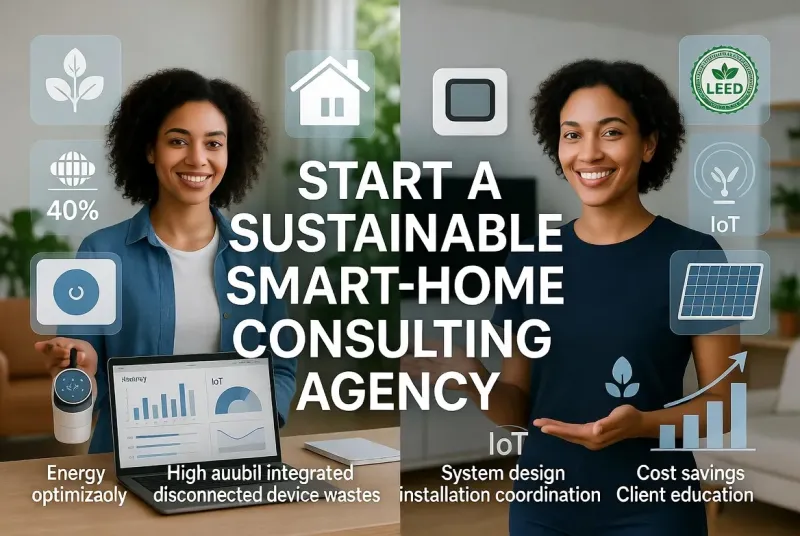
The convergence of sustainability and smart home technology represents one of the most exciting business opportunities of 2026. As homeowners increasingly prioritize energy efficiency, environmental responsibility, and intelligent automation, the demand for expert guidance in creating sustainable smart homes has never been higher. Starting a sustainable smart-home consulting agency positions you at the intersection of three booming industries: green building, IoT technology, and home automation.
In 2026, the U.S. smart home market is projected to exceed $174 billion, with sustainable and energy-efficient solutions driving much of this growth. Homeowners are seeking expert advice on integrating solar panels, smart thermostats, energy monitoring systems, water conservation technologies, and intelligent automation that reduces environmental impact while enhancing comfort and convenience. This creates a lucrative opportunity for consultants who can bridge the gap between complex technology and practical, sustainable living.
This comprehensive step-by-step guide will walk you through everything you need to know to launch a successful sustainable smart-home consulting agency in the USA in 2026. From understanding market opportunities and obtaining certifications to building your service offerings, establishing partnerships, and scaling your business, you'll gain the knowledge and strategies needed to build a profitable, impactful consulting practice that helps homeowners create smarter, greener, more sustainable living spaces.
Understanding the Sustainable Smart-Home Market in 2026
Before launching your consulting agency, it's crucial to understand the market landscape, trends, and opportunities that define the sustainable smart-home industry in 2026.
Market Size and Growth Trends
The sustainable smart-home market is experiencing unprecedented growth driven by several converging factors:
Market Size: The U.S. smart home market reached $174 billion in 2026, with sustainable and energy-efficient solutions accounting for approximately 40% of this market. The sustainable segment is growing at 23% annually, significantly outpacing traditional smart home products.
Key Growth Drivers:
- Rising Energy Costs: Homeowners are investing in smart energy management to reduce utility bills, with average savings of 15-30% through smart home automation
- Climate Change Awareness: 73% of homeowners now consider environmental impact when making home improvement decisions
- Government Incentives: Federal and state tax credits for energy-efficient upgrades (up to 30% for solar, heat pumps, and energy-efficient systems)
- Technology Maturation: Smart home devices have become more affordable, reliable, and user-friendly
- Remote Work Trends: Increased time at home has heightened interest in home automation and efficiency
Target Customer Segments
Understanding your ideal clients helps you tailor services and marketing:
Environmentally Conscious Homeowners (35-65): Motivated by environmental values, willing to invest in sustainable technology, typically mid-to-high income.
Tech-Savvy Early Adopters (25-50): Interested in cutting-edge technology, value convenience and efficiency, comfortable with digital solutions.
Cost-Conscious Upgraders (40-70): Primarily motivated by utility savings, interested in ROI-focused solutions, typically own older homes needing upgrades.
New Construction Clients: Working with builders or building custom homes, interested in integrating sustainability from the ground up.
Real Estate Investors: Looking to increase property value through smart, sustainable upgrades that appeal to buyers or renters.
Competitive Landscape
The consulting landscape in 2026 includes:
- Independent Consultants: Solo practitioners or small agencies (your primary competition)
- Smart Home Installers: Companies offering installation with basic consulting
- Energy Auditors: Traditional energy consultants expanding into smart home tech
- Large Consulting Firms: Enterprise-focused, less accessible to residential clients
- Manufacturer Consultants: Brand-specific consultants (limited to one ecosystem)
Your Competitive Advantage: As an independent sustainable smart-home consultant, you offer unbiased, holistic advice across multiple brands and technologies, with a specific focus on sustainability—something general smart home installers and brand-specific consultants often lack.
Essential Skills and Qualifications
Success in sustainable smart-home consulting requires a combination of technical knowledge, sustainability expertise, business acumen, and interpersonal skills.
Technical Knowledge Areas
Smart Home Technologies:
- Home automation platforms (Control4, Savant, Crestron, Home Assistant)
- Smart thermostats (Nest, Ecobee, Honeywell)
- Energy monitoring systems (Sense, Emporia, Span panels)
- Smart lighting systems (Lutron, Philips Hue, LIFX)
- Smart water management (Moen, Flo by Moen, Rachio)
- Renewable energy systems (solar panels, battery storage)
- Smart appliances and EV charging stations
- Home networking and IoT connectivity (WiFi 6/7, Zigbee, Z-Wave, Matter)
Sustainability Expertise:
- Energy efficiency principles and building science
- Renewable energy systems and integration
- Water conservation technologies
- Indoor air quality and ventilation
- Sustainable building materials and practices
- Carbon footprint calculation and reduction strategies
- Green building certifications (LEED, Energy Star, Passive House)
Recommended Certifications
While not always legally required, certifications build credibility and expertise:
Smart Home Certifications:
- CEDIA Certification: Custom Electronic Design & Installation Association offers various levels of certification
- CompTIA IT Fundamentals: Basic IT knowledge for smart home networking
- Manufacturer Certifications: Nest Pro, Ecobee Pro, Lutron certification programs
- Smart Home Professional (SHP): Industry-recognized certification
Sustainability Certifications:
- RESNET HEP (Home Energy Professional): Energy auditing and rating
- BPI Building Analyst: Building Performance Institute certification
- LEED Green Associate: Leadership in Energy and Environmental Design
- Energy Star Partner: EPA program for energy efficiency
- Certified Energy Manager (CEM): Association of Energy Engineers
Business Certifications:
- Small Business Administration (SBA) Training: Free resources for new business owners
- Professional Liability Insurance: Essential for consulting businesses
Essential Soft Skills
- Communication: Ability to explain complex technology in simple terms
- Problem-Solving: Creative solutions for unique home challenges
- Project Management: Coordinating multiple vendors and installations
- Sales and Marketing: Attracting and converting clients
- Customer Service: Building long-term relationships and referrals
- Continuous Learning: Staying current with rapidly evolving technology
Legal and Business Setup
Proper legal and business structure protects you and establishes credibility with clients.
Choose Your Business Structure
Sole Proprietorship:
- Simplest and least expensive to establish
- You and the business are legally the same
- Personal liability for business debts
- Best for: Testing the business with minimal risk
Limited Liability Company (LLC):
- Most popular for consultants
- Protects personal assets from business liabilities
- Flexible tax options
- Relatively easy to maintain
- Best for: Most sustainable smart-home consultants
S Corporation:
- More complex but potential tax advantages
- Avoids self-employment tax on distributions
- More administrative requirements
- Best for: Established consultants with significant income
Steps to Form an LLC:
- Choose a unique business name
- File Articles of Organization with your state ($50-$500 depending on state)
- Obtain an EIN (Employer Identification Number) from IRS (free)
- Create an Operating Agreement
- Obtain necessary business licenses and permits
- Open a business bank account
Business Licenses and Permits
Requirements vary by location, but typically include:
- General Business License: Required in most cities/counties ($50-$400)
- Professional Services License: May be required for consulting
- Home Occupation Permit: If operating from home
- Sales Tax Permit: If selling products (varies by state)
- Contractor's License: May be required if doing installations (check state requirements)
Important: If you're only providing consulting and not performing installations, you typically don't need a contractor's license. However, requirements vary by state, so verify with your state licensing board.
Insurance Requirements
Protect your business with appropriate insurance:
- Professional Liability Insurance (Errors & Omissions): $500-$2,000/year. Protects against claims of negligence, mistakes, or inadequate work. Essential for consultants.
- General Liability Insurance: $400-$1,500/year. Covers property damage, bodily injury, and advertising injury.
- Cyber Liability Insurance: $500-$3,000/year. Protects against data breaches and cyber attacks (important when handling client home systems).
- Business Owner's Policy (BOP): Bundles general liability and property insurance, often more affordable.
Business Banking and Accounting
Separate Business Finances:
- Open a dedicated business checking account
- Get a business credit card
- Never mix personal and business expenses
Accounting Software:
- QuickBooks Online ($25-$70/month)
- FreshBooks ($15-$50/month)
- Wave (free for basic features)
- Track income, expenses, invoices, and taxes
Set Up Accounting Systems:
- Chart of accounts specific to consulting
- Invoicing system
- Expense tracking
- Quarterly tax estimation and payment
- Annual tax preparation
Defining Your Service Offerings
Clear, well-defined services help clients understand your value and make purchasing decisions easier.
Core Consulting Services
1. Sustainable Smart-Home Assessment ($200-$500)
- Comprehensive evaluation of current home systems
- Energy audit and efficiency analysis
- Identification of upgrade opportunities
- Priority recommendations based on ROI and sustainability impact
- Detailed report with actionable recommendations
- Typical duration: 2-4 hours on-site + report preparation
2. Custom Smart-Home Design & Planning ($500-$2,500)
- Complete smart-home system design
- Product selection and specification
- Integration planning across systems
- Sustainability and energy efficiency optimization
- Installation timeline and sequencing
- Budget planning and vendor recommendations
- 3D visualization or system diagrams
- Typical duration: 1-2 weeks
3. Energy Efficiency Optimization ($400-$1,500)
- Detailed energy consumption analysis
- Smart thermostat programming and optimization
- Lighting efficiency upgrades
- Appliance and plug load management
- Renewable energy integration planning
- Utility rebate and incentive identification
- ROI calculations and payback periods
- Typical savings: 15-30% on energy bills
4. Smart-Home Installation Oversight ($300-$800/day)
- Vendor coordination and management
- Quality control during installation
- System integration verification
- Testing and troubleshooting
- Client training and handover
- Ensuring sustainability goals are met
- Typical projects: 1-5 days
5. Smart-Home System Integration ($600-$2,000)
- Connecting disparate smart-home systems
- Creating automation routines and scenes
- Voice assistant integration (Alexa, Google, Siri)
- Mobile app configuration
- Security and privacy optimization
- Energy monitoring setup
- Typical duration: 1-3 days
Specialized Services
6. Renewable Energy Integration Consulting ($800-$3,000)
- Solar panel system sizing and placement
- Battery storage planning (Tesla Powerwall, etc.)
- EV charging station integration
- Grid-tie and off-grid system design
- Incentive and financing guidance
- Utility interconnection assistance
7. Water Conservation & Smart Irrigation ($400-$1,200)
- Smart irrigation system design
- Leak detection system planning
- Water monitoring and management
- Rainwater harvesting integration
- Greywater system consulting
- Water efficiency audits
8. Smart-Home Security & Privacy Audit ($300-$800)
- Network security assessment
- Device vulnerability analysis
- Privacy settings optimization
- Data protection recommendations
- Secure network configuration
- Ongoing security monitoring setup
9. New Construction Smart-Home Consulting ($1,500-$5,000)
- Pre-wiring and infrastructure planning
- System design from ground up
- Builder and architect coordination
- Future-proofing recommendations
- Integration with sustainable building practices
- Multiple site visits throughout construction
10. Ongoing Support & Maintenance Plans ($50-$200/month)
- Monthly system health checks
- Software updates and optimization
- Remote troubleshooting
- Priority support
- Quarterly performance reports
- Energy savings tracking
- System upgrades and enhancements
Package Offerings
Create bundled packages for different client needs:
Starter Package ($1,200-$2,000):
- Sustainable smart-home assessment
- Basic system design
- Product recommendations
- Implementation roadmap
- 1-hour follow-up consultation
Comprehensive Package ($3,000-$6,000):
- Complete home assessment
- Custom system design
- Energy efficiency optimization
- Vendor coordination
- Installation oversight (up to 2 days)
- System integration
- Client training
- 3 months of support
Premium Package ($7,000-$15,000):
- Everything in Comprehensive
- Renewable energy integration
- Water conservation systems
- Advanced automation design
- Installation oversight (up to 5 days)
- 6 months of support
- Annual system optimization
Pricing Strategies and Revenue Models
Pricing your services appropriately is crucial for profitability and competitiveness.
Pricing Models
Hourly Consulting:
- Rate Range: $75-$200/hour depending on experience and location
- Best For: Small projects, troubleshooting, ongoing support
- Pros: Simple, fair for both parties, easy to estimate
- Cons: Income ceiling, clients may worry about runaway costs
- Entry-Level: $75-$100/hour
- Mid-Level: $100-$150/hour
- Expert-Level: $150-$200+/hour
Project-Based Pricing:
- Best For: Well-defined projects with clear scope
- Pros: Predictable income, clients know total cost upfront
- Cons: Requires accurate scoping, scope creep risk
- Examples:
- Smart-home assessment: $300-$500
- System design: $1,000-$3,000
- Full home integration: $3,000-$10,000
Value-Based Pricing:
- Best For: High-impact projects with measurable ROI
- Pros: Aligns your success with client success, higher earning potential
- Cons: Difficult to quantify, requires trust
- Examples:
- Percentage of energy savings (10-20% of first-year savings)
- Percentage of project value (5-15%)
- Fixed fee based on value delivered
Retainer Model:
- Best For: Ongoing relationships, recurring revenue
- Monthly Retainer: $200-$1,000/month
- Includes: X hours of consulting, priority support, system monitoring
- Pros: Predictable income, deeper client relationships
- Cons: Requires consistent delivery, may limit capacity
Revenue Projections
Year 1 (Building Phase):
- Clients per month: 2-4
- Average project value: $1,500
- Monthly revenue: $3,000-$6,000
- Annual revenue: $36,000-$72,000
Year 2 (Growth Phase):
- Clients per month: 4-8
- Average project value: $2,000
- Monthly revenue: $8,000-$16,000
- Annual revenue: $96,000-$192,000
Year 3+ (Established Phase):
- Clients per month: 8-15
- Average project value: $2,500
- Monthly revenue: $20,000-$37,500
- Annual revenue: $240,000-$450,000
- Potential to hire associates or scale further
Additional Revenue Streams
Product Sales Commission:
- Partner with manufacturers and retailers
- Earn 5-15% commission on referred sales
- Must disclose commissions to maintain trust
Affiliate Marketing:
- Recommend products through affiliate links
- Earn commissions on online sales
- Create content (blog, YouTube) to drive traffic
Educational Products:
- Online courses on smart-home sustainability
- E-books and guides
- Webinars and workshops
- Passive income potential
Vendor Partnerships:
- Preferred installer/referral partnerships
- Training and certification programs
- Co-marketing opportunities
Building Your Brand and Online Presence
A strong brand and online presence are essential for attracting clients in 2026.
Brand Development
Define Your Unique Value Proposition (UVP):
- What makes you different from competitors?
- What specific problems do you solve?
- What results do you deliver?
- Example UVP: "I help environmentally conscious homeowners reduce energy costs by 30% while creating intelligent, sustainable living spaces through expert smart-home consulting."
Brand Elements:
- Business Name: Memorable, relevant, available domain
- Logo: Professional, reflects sustainability and technology
- Color Scheme: Greens, blues (sustainability + tech)
- Brand Voice: Knowledgeable, approachable, trustworthy
- Tagline: Clear, concise statement of value
Professional Website
Essential Pages:
- Homepage: Clear value proposition, services overview, call-to-action
- Services: Detailed descriptions, pricing ranges, benefits
- About: Your story, credentials, certifications, why you do this
- Portfolio/Case Studies: Before/after examples, client results
- Testimonials: Client reviews and success stories
- Blog/Resources: Educational content, industry insights
- Contact: Easy ways to reach you, consultation booking
Website Features:
- Mobile-responsive design (essential in 2026)
- Fast loading speed (under 3 seconds)
- SSL certificate (security)
- Online scheduling (Calendly, Acuity)
- Contact forms
- Live chat or chatbot
- Email list signup
- Social media integration
Website Platforms:
- WordPress (most flexible, $100-$500/year)
- Squarespace (easy, beautiful, $200-$400/year)
- Webflow (modern, powerful, $200-$500/year)
- Wix (simple, affordable, $150-$300/year)
Content Marketing Strategy
Blog Content Ideas:
- "10 Smart-Home Upgrades That Reduce Energy Bills by 30%"
- "Complete Guide to Sustainable Smart-Home Technology in 2026"
- "Solar + Smart Home: Maximizing Your Investment"
- "Smart Thermostat Showdown: Nest vs. Ecobee vs. Honeywell"
- "How to Future-Proof Your Smart-Home Investment"
- "The ROI of Smart-Home Energy Efficiency"
- "Water Conservation Through Smart Technology"
- "Smart-Home Security: Protecting Your Privacy"
Content Calendar:
- Post 2-4 blog articles per month
- Create comprehensive guides (2,000+ words)
- Include case studies and real examples
- Optimize for SEO (keywords, meta descriptions, headers)
- Include visuals (images, infographics, videos)
Video Content:
- YouTube channel with tutorials and reviews
- Client testimonials and case studies
- Live Q&A sessions
- Product demonstrations
- Behind-the-scenes of installations
Social Media Strategy
Primary Platforms for 2026:
- LinkedIn: B2B networking, professional credibility, contractor partnerships
- Instagram: Visual before/after projects, behind-the-scenes, stories
- Facebook: Community groups, local marketing, client testimonials
- YouTube: Educational content, product reviews, tutorials
- TikTok: Quick tips, trending sustainability topics (if targeting younger demographic)
Content Strategy:
- Post 3-5 times per week
- Mix educational, promotional, and engaging content
- Use relevant hashtags (#SmartHome #Sustainability #GreenTech #HomeAutomation)
- Engage with followers (respond to comments, DMs)
- Collaborate with complementary businesses
- Share client success stories (with permission)
Search Engine Optimization (SEO)
Local SEO (Critical for Consulting):
- Google Business Profile (formerly Google My Business)
- Optimize for local keywords: "sustainable smart-home consultant [city]"
- Get reviews from clients
- Local citations (Yelp, Angie's List, HomeAdvisor)
- Local backlinks (chamber of commerce, local news)
On-Page SEO:
- Keyword research (use tools like Ahrefs, SEMrush, Ubersuggest)
- Optimize page titles, meta descriptions, headers
- Internal linking between pages
- Image optimization (alt text, file size)
- Mobile optimization
- Page speed optimization
Content SEO:
- Target long-tail keywords (less competition, higher intent)
- Create comprehensive, valuable content
- Answer common questions (FAQ schema)
- Regular content updates
- Build backlinks through guest posting, partnerships
Client Acquisition and Marketing
Attracting and converting clients is essential for business growth.
Target Market Identification
Ideal Client Profile:
- Demographics: Homeowners, 35-65, household income $75k+
- Psychographics: Environmentally conscious, tech-savvy, value convenience
- Geographics: Your service area (local, regional, or national for remote consulting)
- Behavioral: Recently purchased home, planning renovation, high energy bills
Marketing Channels
1. Referral Program:
- Your best source of qualified leads
- Offer incentives: $100-$300 referral fee or service discount
- Ask satisfied clients for referrals
- Partner with complementary businesses (realtors, contractors, architects)
- Make it easy: referral cards, email templates, online forms
2. Strategic Partnerships:
- Real Estate Agents: Refer clients buying/selling homes
- Home Builders: New construction consulting
- General Contractors: Renovation projects
- Architects: Integrated design consulting
- Electricians/HVAC Technicians: Installation partnerships
- Solar Installers: Complementary services
- Interior Designers: Smart-home integration
Partnership Strategy:
- Identify 10-20 potential partners in your area
- Reach out with personalized introduction
- Offer value first (free consultation for their clients)
- Create formal referral agreements
- Co-market through webinars, workshops, content
- Regular check-ins and relationship building
3. Online Advertising:
- Google Ads:
- Search ads for "smart-home consultant [city]"
- Budget: $500-$2,000/month
- Cost per click: $3-$15
- Conversion rate: 3-7%
- Facebook/Instagram Ads:
- Target homeowners, interests in sustainability/technology
- Budget: $300-$1,500/month
- Retargeting website visitors
- Lead generation campaigns
- LinkedIn Ads:
- Target professionals, homeowners
- Higher cost but quality leads
- Budget: $500-$2,000/month
4. Content Marketing:
- Blog posts optimized for SEO
- YouTube videos (tutorials, reviews, case studies)
- Podcast appearances
- Guest posting on industry blogs
- Free resources (guides, checklists, calculators)
- Webinars and online workshops
5. Local Marketing:
- Google Business Profile optimization
- Local Facebook groups
- Nextdoor app
- Chamber of Commerce membership
- Local home shows and expos
- Sponsorship of local events
- Direct mail to targeted neighborhoods
6. Email Marketing:
- Build email list through website opt-ins
- Offer lead magnet (free guide, consultation, assessment)
- Newsletter with tips, case studies, offers
- Automated email sequences for leads
- Segment by interest (energy efficiency, security, automation)
- Tools: Mailchimp, ConvertKit, ActiveCampaign
Sales Process
Lead Generation:
- Website contact forms
- Phone calls
- Email inquiries
- Social media DMs
- Referrals
- Networking events
Initial Consultation (Free, 30-60 minutes):
- Understand client goals and challenges
- Assess current home systems
- Educate on possibilities
- Build rapport and trust
- Qualify the lead (budget, timeline, commitment)
- Present your services and process
Proposal Development:
- Detailed scope of work
- Deliverables and timeline
- Investment/pricing
- Terms and conditions
- Case studies or examples
- Clear next steps
Follow-Up:
- Send proposal within 48 hours
- Schedule follow-up call in 3-5 days
- Address questions and concerns
- Provide additional information as needed
- Create urgency (limited availability, seasonal promotions)
Closing:
- Make it easy to say yes (simple contract, payment options)
- Offer payment plans if needed
- Get signed contract and deposit
- Onboard client smoothly
- Set expectations clearly
Conversion Optimization
Typical Conversion Rates:
- Website visitor to lead: 2-5%
- Lead to consultation: 20-40%
- Consultation to proposal: 60-80%
- Proposal to close: 30-50%
- Overall: 1-4% of website visitors become clients
Improving Conversions:
- Clear, compelling value proposition
- Social proof (testimonials, case studies, reviews)
- Professional presentation
- Responsive communication (within 24 hours)
- Transparent pricing
- Risk reversal (guarantees, warranties)
- Multiple contact options
- Easy scheduling
Tools and Technology Stack
The right tools streamline your operations and enhance service delivery.
Business Management Tools
CRM (Customer Relationship Management):
- HubSpot CRM: Free tier available, powerful features
- Pipedrive: Sales-focused, $15-$99/month
- Zoho CRM: Affordable, comprehensive, $12-$40/month
- Monday.com: Visual, customizable, $8-$24/month
Project Management:
- Asana: Task management, $11-$25/month
- Trello: Visual boards, free-$17/month
- ClickUp: All-in-one, free-$19/month
- Notion: Flexible workspace, free-$15/month
Scheduling:
- Calendly: Easy scheduling, free-$15/month
- Acuity Scheduling: Robust features, $16-$45/month
- Google Calendar: Free, integrates with other tools
Communication Tools
Video Conferencing:
- Zoom: Industry standard, free-$20/month
- Google Meet: Integrated with Google Workspace, free-$18/month
- Microsoft Teams: Good for collaboration, free-$22/month
Messaging:
- Slack: Team communication, free-$12/month
- WhatsApp Business: Client communication, free
- TextMagic: SMS marketing, pay-per-use
Design and Presentation Tools
Proposal/Contract:
- PandaDoc: Professional proposals, $19-$49/month
- Proposify: Beautiful proposals, $49-$99/month
- DocuSign: E-signatures, $10-$40/month
- HelloSign: Simple e-signatures, free-$15/month
Design:
- Canva: Easy graphics, free-$13/month
- Adobe Creative Cloud: Professional design, $53/month
- Figma: UI/UX design, free-$15/month
Smart-Home Specific Tools
System Design:
- SmartThings: Samsung ecosystem
- Home Assistant: Open-source, highly customizable
- Hubitat: Local control, privacy-focused
- Control4 Designer: Professional (requires certification)
Energy Monitoring:
- Sense: Real-time energy monitoring
- Emporia Vue: Affordable monitoring
- Span Smart Panel: Advanced panel monitoring
Network Analysis:
- WiFi Analyzer apps: Network optimization
- Fing: Network scanning
- Ubiquiti UniFi: Professional networking
Financial Tools
Accounting:
- QuickBooks Online: Industry standard, $25-$70/month
- FreshBooks: User-friendly, $15-$50/month
- Wave: Free for basic features
- Xero: Cloud-based, $13-$70/month
Invoicing:
- Stripe: Payment processing, 2.9% + $0.30 per transaction
- Square: Easy invoicing, 2.9% + $0.30
- PayPal: Widely accepted, 2.9% + $0.30
- Wave Invoicing: Free invoicing
Marketing Tools
Email Marketing:
- Mailchimp: Popular, free-$299/month
- ConvertKit: Creator-focused, $15-$79/month
- ActiveCampaign: Advanced automation, $15-$149/month
- Constant Contact: Easy to use, $12-$80/month
Social Media Management:
- Buffer: Simple scheduling, free-$10/month
- Hootsuite: Comprehensive, $49-$599/month
- Later: Visual planning, free-$25/month
- Sprout Social: Advanced analytics, $99-$249/month
SEO Tools:
- Google Search Console: Free
- Google Analytics: Free
- SEMrush: Comprehensive, $120-$450/month
- Ahrefs: Backlink analysis, $99-$999/month
- Ubersuggest: Budget-friendly, $12-$40/month
Building Strategic Partnerships
Partnerships accelerate growth and expand your service capabilities.
Types of Partnerships
Installation Partners:
- Electricians
- HVAC technicians
- Low-voltage specialists
- Network/IT professionals
- Solar installers
Referral Partners:
- Real estate agents
- Home inspectors
- Mortgage brokers
- Insurance agents
- Interior designers
- Architects
- General contractors
Product Partners:
- Smart-home manufacturers
- Distributors
- Retailers
- Software companies
Partnership Development Strategy
Step 1: Identify Potential Partners
- Research local businesses in complementary fields
- Attend industry events and networking groups
- Join professional associations (CEDIA, RESNET, USGBC)
- Ask existing clients for recommendations
- Search online directories and review sites
Step 2: Initial Outreach
- Personalized email or phone call
- Reference mutual connections if possible
- Explain mutual benefits clearly
- Offer value first (free consultation for their clients)
- Suggest a coffee meeting or video call
Step 3: Build the Relationship
- Meet regularly (monthly or quarterly)
- Understand their business and challenges
- Share knowledge and resources
- Co-create content (webinars, blog posts)
- Refer clients to them consistently
Step 4: Formalize the Partnership
- Create a referral agreement
- Define commission structure (if applicable)
- Establish communication protocols
- Set expectations for response times
- Create co-marketing opportunities
Partnership Benefits
For You:
- Steady stream of qualified referrals
- Expanded service capabilities
- Increased credibility through association
- Access to partner's network
- Shared marketing costs
- Learning opportunities
For Partners:
- Additional revenue stream (referral fees)
- Enhanced service offerings for their clients
- Expertise they don't have in-house
- Competitive advantage
- Stronger client relationships
Managing Partnerships
Best Practices:
- Communicate regularly and transparently
- Honor commitments and deadlines
- Provide excellent service to referred clients
- Give credit and recognition
- Be responsive to partner needs
- Track referrals and results
- Review and optimize partnerships annually
Partnership Tracking:
- Number of referrals received
- Conversion rate of referrals
- Revenue from partnerships
- Referrals sent to partner
- Partner satisfaction
- ROI of partnership activities
Scaling Your Consulting Business
Once established, strategic scaling increases revenue and impact.
Growth Strategies
1. Hire Support Staff:
- Virtual Assistant: Administrative tasks, scheduling, email management ($15-$30/hour)
- Junior Consultant: Handle assessments, basic installations ($40-$60/hour)
- Marketing Specialist: Manage social media, content, ads ($40-$75/hour)
- Project Manager: Oversee multiple projects ($50-$80/hour)
When to Hire:
- You're turning away work due to capacity
- Working 60+ hours/week consistently
- Revenue can support salary + benefits
- You're spending too much time on non-billable tasks
2. Expand Service Area:
- Remote consulting (virtual assessments, design)
- Partner with local installers in new markets
- Hire consultants in other regions
- Create online courses/products (scalable)
3. Develop Passive Income Streams:
- Online Courses: "DIY Smart-Home Sustainability" ($197-$997)
- E-books/Guides: Comprehensive guides ($27-$97)
- Membership Site: Ongoing education, community ($29-$99/month)
- Affiliate Marketing: Product recommendations (5-15% commission)
- Software/App: Custom tools for homeowners or consultants
4. Create Tiered Service Levels:
- DIY Support: Phone/email consulting ($75-$150/hour)
- Standard: Assessment + design ($1,500-$3,000)
- Premium: Full-service consulting + oversight ($5,000-$15,000)
- Enterprise: Multiple properties, ongoing support ($20,000+)
5. Specialize in a Niche:
- Luxury homes
- Historic home retrofits
- Multi-family buildings
- Commercial properties
- Net-zero homes
- Specific technologies (solar + storage, water conservation)
Systems and Processes
Document Everything:
- Standard Operating Procedures (SOPs)
- Client onboarding process
- Assessment templates
- Proposal templates
- Project management workflows
- Quality control checklists
- Client communication protocols
Automation:
- Email sequences for leads and clients
- Scheduling automation
- Invoicing and payment reminders
- Social media scheduling
- Report generation
- Client feedback surveys
Financial Management for Growth
Key Metrics to Track:
- Monthly recurring revenue (MRR)
- Customer acquisition cost (CAC)
- Lifetime value (LTV) of client
- Profit margins by service
- Cash flow projections
- Utilization rate (billable hours)
- Client satisfaction scores
Reinvestment Strategy:
- Reinvest 20-30% of profits into growth
- Marketing and advertising
- Technology and tools
- Training and certifications
- Hiring and team development
Challenges and Solutions
Anticipating challenges helps you navigate them effectively.
Common Challenges
Challenge 1: Rapidly Changing Technology
- Solution: Dedicate 5-10 hours/week to learning, join professional associations, attend trade shows, follow industry publications, participate in online communities
Challenge 2: Client Education
- Solution: Create educational content, use simple language, provide visual aids, offer free consultations, build trust through transparency
Challenge 3: Price Objections
- Solution: Clearly communicate ROI, offer payment plans, provide tiered options, share case studies with savings data, emphasize long-term value
Challenge 4: Competition
- Solution: Differentiate through specialization, exceptional service, sustainability focus, build strong brand, leverage testimonials and case studies
Challenge 5: Scope Creep
- Solution: Detailed contracts, clear scope of work, change order process, regular communication, project management tools
Challenge 6: Cash Flow
- Solution: Require deposits (30-50%), milestone payments, invoice promptly, follow up on late payments, maintain cash reserve (3-6 months expenses)
Future Trends and Opportunities
Staying ahead of trends positions you for long-term success.
Emerging Trends in 2026 and Beyond
1. AI Integration:
- AI-powered energy optimization
- Predictive maintenance
- Voice and gesture control advancement
- Machine learning for personalization
2. Matter Protocol:
- Universal smart-home standard
- Improved interoperability
- Simplified installation and setup
- Greater consumer confidence
3. Energy Independence:
- Solar + battery storage growth
- Vehicle-to-home (V2H) integration
- Microgrids and community energy
- Grid-interactive efficient buildings
4. Health and Wellness:
- Indoor air quality monitoring
- Circadian lighting systems
- Water quality monitoring
- Wellness-focused automation
5. Climate Resilience:
- Extreme weather preparedness
- Water conservation urgency
- Fire detection and prevention
- Flood monitoring systems
6. Privacy and Security:
- Increased focus on data privacy
- Local processing vs. cloud
- Cybersecurity for smart homes
- Encryption and security standards
Opportunities for Consultants
- Specialize in emerging technologies
- Offer climate resilience consulting
- Develop expertise in health/wellness systems
- Provide privacy and security audits
- Create educational content and courses
- Consult for builders and developers
- Partner with utilities and municipalities
Frequently Asked Questions
How much does it cost to start a sustainable smart-home consulting agency?
Initial Investment:
- Business registration and licenses: $200-$1,000
- Insurance (first year): $1,500-$4,000
- Tools and software (first year): $2,000-$5,000
- Website and branding: $1,000-$5,000
- Marketing (first 3 months): $1,500-$5,000
- Training and certifications: $1,000-$5,000
- Equipment (laptop, tablet, tools): $2,000-$5,000
- Total: $10,000-$30,000
You can start leaner ($5,000-$10,000) by bootstrapping and using free tools initially, then reinvesting revenue into growth.
Do I need technical certifications to start?
No, certifications aren't legally required to start a consulting business. However, they significantly enhance credibility and expertise. Recommended starting certifications:
- Smart Home Professional (SHP) or equivalent
- Manufacturer certifications (Nest, Ecobee, etc.)
- Energy efficiency certification (RESNET, BPI)
- Business license and insurance
You can start with basic knowledge and obtain certifications as you grow.
How long does it take to become profitable?
Typical Timeline:
- Months 1-3: Setup, training, marketing, first clients (-$2,000 to -$5,000/month)
- Months 4-6: Building client base, refining services ($2,000-$5,000/month)
- Months 7-12: Establishing reputation, consistent clients ($5,000-$10,000/month)
- Year 2: Profitable, scaling ($8,000-$15,000/month)
- Year 3+: Established, optimizing ($15,000-$30,000+/month)
Most consultants break even within 6-12 months and become consistently profitable in year 2.
Can I run this business part-time?
Yes, many successful consultants start part-time while maintaining other income. Part-time approach:
- Start with 10-15 hours/week
- Focus on evenings and weekends initially
- Take on 1-2 clients per month
- Gradually increase as you gain confidence
- Transition to full-time when revenue replaces 75% of current income
Part-time consulting can generate $2,000-$5,000/month while building toward full-time.
What's the biggest mistake new consultants make?
Common Mistakes:
- Underpricing services: Not valuing expertise appropriately
- Lack of niche focus: Trying to serve everyone
- Poor marketing: Not investing in lead generation
- No systems: Reinventing the wheel for each client
- Scope creep: Not defining project boundaries clearly
- Ignoring cash flow: Not managing finances properly
- Not building relationships: Focusing only on transactions
Avoid These By: Researching market rates, specializing, creating marketing plan, documenting processes, using contracts, tracking finances, building genuine relationships.
Should I focus on residential or commercial?
Residential:
- Lower barrier to entry
- More clients, smaller projects
- Faster sales cycles
- More personal relationships
- Average project: $1,500-$10,000
Commercial:
- Higher-value projects
- Longer sales cycles
- More complex requirements
- Need commercial experience/credentials
- Average project: $10,000-$100,000+
Recommendation: Start with residential to build experience and cash flow, then expand into commercial as you grow.
How do I stay competitive with big companies?
Your Advantages as an Independent Consultant:
- Personalized service and attention
- Unbiased recommendations (not tied to specific brands)
- Lower overhead = competitive pricing
- Faster response times
- Local market knowledge
- Flexibility and customization
- Direct relationship with owner/expert
Compete By: Emphasizing personalization, building strong brand, leveraging testimonials, specializing in niche, providing exceptional service, staying current with technology.
Conclusion
Starting a sustainable smart-home consulting agency in 2026 positions you at the exciting intersection of technology, sustainability, and home improvement. With the market growing rapidly and homeowners increasingly prioritizing energy efficiency and intelligent automation, the opportunity has never been better.
Success in this field requires a combination of technical knowledge, business acumen, marketing skills, and genuine passion for helping people create smarter, more sustainable homes. By following the step-by-step guide outlined in this article—from obtaining certifications and setting up your business legally, to defining services, pricing appropriately, building your brand, acquiring clients, and scaling strategically—you'll be well-positioned to build a profitable, impactful consulting practice.
Remember that building a successful consulting business takes time, dedication, and continuous learning. Start where you are, use what you have, and take consistent action toward your goals. Focus on delivering exceptional value to your clients, building strong relationships, and staying current with emerging technologies and trends.
The sustainable smart-home industry is poised for tremendous growth in the coming years. By establishing yourself now as a trusted expert in this field, you're not just building a business—you're contributing to a more sustainable future, one smart home at a time.
Your journey starts today. Take the first step, whether that's researching certifications, registering your business, or reaching out to your first potential partner. The future of sustainable smart homes is bright, and there's a place for you in this exciting industry.
Welcome to your new career as a sustainable smart-home consultant. The homes of tomorrow need your expertise today.