Evidence-Based Strategies for Toned, Strong Legs
The desire for slimmer, more toned thighs is one of the most common fitness goals, yet it's also one of the most misunderstood. Social media is flooded with quick-fix promises—7-day thigh slimming challenges, magic creams, and spot-reduction workouts that claim to melt fat from specific areas. But the science tells a different story: sustainable leg toning requires a comprehensive approach that combines targeted strength training, cardiovascular exercise, nutritional strategies, and an understanding of how your body actually works.
Thigh fat is often the last to go. For many people, especially women, the thighs and hips are genetically predisposed fat storage areas. This isn't a flaw—it's an evolutionary adaptation. But understanding the science behind fat loss, muscle development, and body composition can help you work with your biology rather than against it, achieving results that are not only visible but sustainable and healthy.
This comprehensive, science-backed guide cuts through the myths and misinformation to provide you with evidence-based strategies for slimmer, stronger, more toned thighs. You'll learn why spot reduction doesn't work (and what does), which exercises actually target thigh muscles effectively, how nutrition impacts leg fat loss, and the lifestyle factors that can accelerate or sabotage your progress. Whether you're looking to reduce thigh circumference, increase muscle definition, or simply feel more confident in your legs, this guide provides the roadmap to get there safely and sustainably.
Understanding Thigh Anatomy and Fat Distribution
The Muscles That Shape Your Thighs
To effectively tone your thighs, you must first understand the muscle groups involved:
Quadriceps (Front of Thigh): This large muscle group consists of four muscles (rectus femoris, vastus lateralis, vastus medialis, and vastus intermedius) responsible for knee extension and hip flexion. Well-developed quads create the toned, athletic look on the front of your thighs.
Hamstrings (Back of Thigh): These three muscles (biceps femoris, semitendinosus, and semimembranosus) run along the back of your thigh and are responsible for knee flexion and hip extension. Strong hamstrings create definition and balance to prevent muscle imbalances.
Adductors (Inner Thigh): This group of five muscles (adductor longus, brevis, magnus, gracilis, and pectineus) brings your legs together. These are the muscles most people want to "tighten" when they talk about inner thigh toning.
Abductors (Outer Thigh/Hips): Including the gluteus medius and minimus, these muscles move your legs away from your body's midline and stabilize your pelvis. Strong abductors create the toned look on the outer thigh and hip area.
Scientific insight: Dr. Jennifer Martinez, exercise physiologist and sports scientist, explains: "You can't selectively burn fat from your thighs through exercise alone, but you can build muscle in specific areas to create a more toned, defined appearance. The combination of fat loss through caloric deficit and muscle development through resistance training is what creates the slimmer thigh look people desire."
Why Thigh Fat Is So Stubborn
Several biological factors make thigh fat particularly resistant to loss:
Genetic predisposition: Your genes determine where your body preferentially stores and loses fat. For many women, the thighs and hips are "first on, last off" fat storage areas due to higher concentrations of alpha-adrenergic receptors, which inhibit fat breakdown.
Hormonal influences: Estrogen promotes fat storage in the lower body (thighs, hips, buttocks) as a reproductive adaptation. This is why women typically have more thigh fat than men and why thigh fat can be particularly stubborn.
Alpha vs. beta receptors: Fat cells contain receptors that either promote fat breakdown (beta receptors) or inhibit it (alpha receptors). Thigh fat cells have a higher ratio of alpha receptors, making them more resistant to lipolysis (fat breakdown).
Insulin sensitivity: Thigh fat is actually more metabolically active and insulin-sensitive than abdominal fat, which is healthier but can make it more stubborn to lose.
Body Fat Percentage vs. Spot Reduction
The myth of spot reduction: Despite countless products and exercises claiming to target thigh fat specifically, scientific research consistently shows that spot reduction is a myth. A landmark study published in the Journal of Strength and Conditioning Research found that participants who performed leg exercises 3 times per week for 12 weeks showed no significant fat loss in the trained leg compared to the untrained leg.
How fat loss actually works: When you create a caloric deficit (burning more calories than you consume), your body draws from fat stores throughout your entire body, not just the area you're exercising. The pattern of fat loss is largely determined by genetics, gender, age, and hormone levels.
The solution: Focus on overall body fat reduction through a combination of diet, cardiovascular exercise, and full-body strength training, while using targeted thigh exercises to build muscle definition. As your overall body fat percentage decreases, your thighs will slim down along with the rest of your body.
Evidence-Based Exercises for Thigh Toning
Compound Movements: The Foundation
Compound exercises work multiple muscle groups simultaneously, burning more calories and building functional strength. These should form the foundation of your thigh-toning routine.
Squats:
- Muscles worked: Quadriceps, hamstrings, glutes, adductors, calves
- Why they work: Squats are the king of lower body exercises, engaging all major thigh muscles while also activating your core and glutes
- Proper form: Feet shoulder-width apart, chest up, weight in heels, lower until thighs are parallel to floor (or as low as comfortable), drive through heels to stand
- Progression: Bodyweight → goblet squats → barbell squats → jump squats
- Reps/sets: 3-4 sets of 10-15 reps
Lunges:
- Muscles worked: Quadriceps, hamstrings, glutes, adductors, calves
- Why they work: Lunges work each leg independently, correcting muscle imbalances and providing deep engagement of thigh muscles
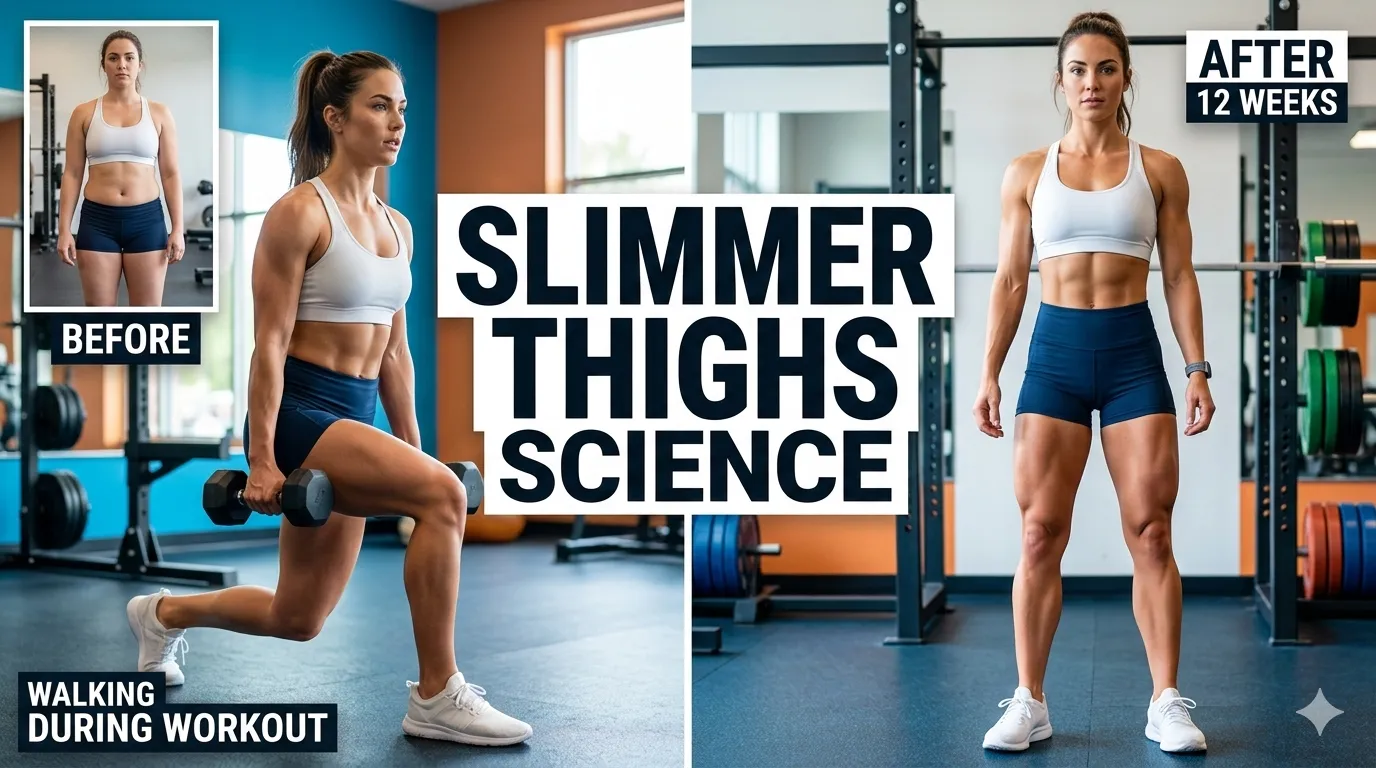
- Variations: Forward lunges, reverse lunges, lateral lunges, walking lunges, curtsy lunges
- Proper form: Step forward/backward/sideways, lower until both knees are at 90 degrees, keep front knee over ankle, push through front heel to return
- Reps/sets: 3 sets of 10-12 reps per leg
Deadlifts:
- Muscles worked: Hamstrings, glutes, lower back, quadriceps
- Why they work: Deadlifts are the best exercise for posterior chain development, particularly targeting the often-neglected hamstrings
- Variations: Romanian deadlifts, conventional deadlifts, sumo deadlifts, single-leg deadlifts
- Proper form: Hinge at hips, keep back straight, lower weight along legs, drive through heels to stand, squeeze glutes at top
- Reps/sets: 3-4 sets of 8-12 reps
Targeted Thigh Exercises
While compound movements should be your foundation, these isolation exercises can help target specific thigh areas:
Inner Thigh Focus:
- Sumo squats: Wide stance with toes pointed outward targets adductors more than regular squats
- Side-lying leg lifts: Lie on side, lift bottom leg up, focusing on inner thigh engagement
- Copenhagen planks: Advanced exercise that intensely works adductors
- Inner thigh machine: If you have gym access, this isolates the adductors
- Reps/sets: 3 sets of 12-15 reps
Outer Thigh and Hip Focus:
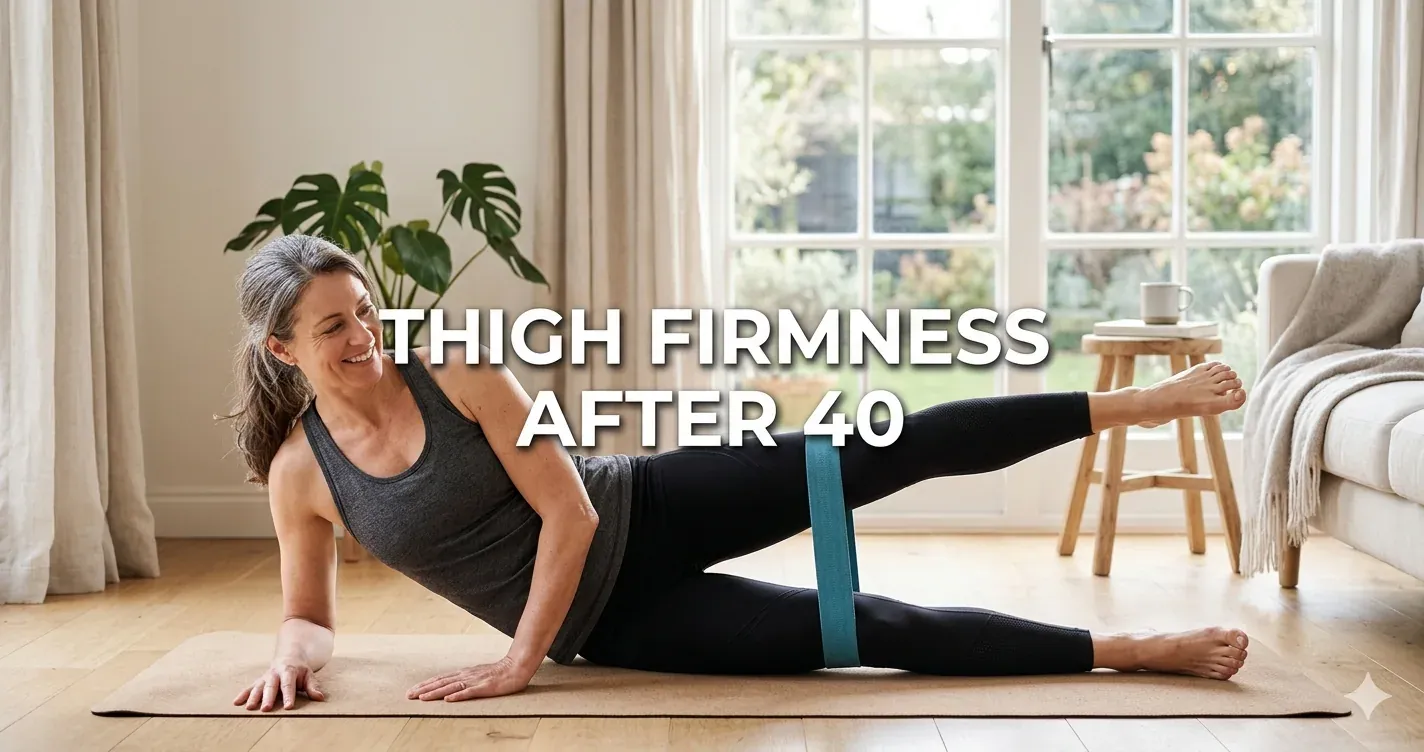
- Clamshells: Lie on side with knees bent, lift top knee while keeping feet together
- Side-lying leg raises: Lift top leg straight up, focusing on outer thigh and hip
- Cable hip abductions: Stand sideways to cable machine, lift leg out to side
- Fire hydrants: On all fours, lift bent leg out to side like a dog at a fire hydrant
- Reps/sets: 3 sets of 15-20 reps
Quadriceps Focus:
- Leg extensions: Machine exercise that isolates the quads
- Step-ups: Step onto elevated surface, driving through heel
- Bulgarian split squats: Rear foot elevated, deeply targets front leg quads
- Wall sits: Isometric hold that burns out the quads
- Reps/sets: 3 sets of 10-15 reps (or 30-60 second holds for isometrics)
Hamstrings Focus:
- Leg curls: Machine exercise targeting hamstrings
- Glute-ham raises: Advanced bodyweight exercise for posterior chain
- Single-leg Romanian deadlifts: Unilateral movement for hamstring development
- Nordic curls: Eccentric hamstring exercise (very challenging)
- Reps/sets: 3 sets of 10-12 reps
High-Intensity Interval Training (HIIT) for Thigh Fat Loss
HIIT combines short bursts of intense exercise with recovery periods, creating a metabolic effect that burns calories during and after your workout (the "afterburn effect" or EPOC—excess post-exercise oxygen consumption).
Why HIIT works for thigh fat:
- Increases calorie burn during and after workout
- Preserves muscle mass while losing fat
- Improves insulin sensitivity, aiding fat loss
- Time-efficient (20-30 minutes vs. 60 minutes of steady cardio)
Thigh-Focused HIIT Workout:
- Jump squats: 30 seconds
- Rest: 15 seconds
- Mountain climbers: 30 seconds
- Rest: 15 seconds
- Alternating lunges: 30 seconds
- Rest: 15 seconds
- High knees: 30 seconds
- Rest: 15 seconds
- Repeat circuit 3-4 times
Frequency: 2-3 times per week, with at least 48 hours between sessions for recovery
The Role of Cardiovascular Exercise
Steady-State Cardio vs. HIIT
Both forms of cardio have merit for thigh toning and fat loss:
Steady-State Cardio (LISS - Low-Intensity Steady State):
- Examples: Walking, jogging, cycling, swimming at moderate pace
- Benefits: Burns calories during exercise, low impact, sustainable for longer durations, promotes recovery
- Duration: 30-60 minutes
- Frequency: 3-5 times per week
- Best for: Building aerobic base, active recovery, total calorie burn
High-Intensity Interval Training (HIIT):
- Examples: Sprint intervals, circuit training, Tabata
- Benefits: EPOC effect (burns calories post-workout), time-efficient, preserves muscle mass, improves metabolic rate
- Duration: 15-30 minutes
- Frequency: 2-3 times per week
- Best for: Maximizing fat loss in minimal time, improving athletic performance
Optimal approach: Combine both! Research shows that a combination of LISS and HIIT produces superior fat loss results compared to either alone. Aim for 2-3 HIIT sessions and 2-3 LISS sessions per week.
Cardio Exercises That Target Thighs
While all cardio contributes to overall fat loss, these exercises particularly engage thigh muscles:
Cycling:
- Engages quads, hamstrings, and glutes throughout the pedal stroke
- Adjust resistance to increase thigh muscle engagement
- Low-impact option for those with joint concerns
- 30-45 minutes at moderate intensity or 20-minute HIIT intervals
Stair Climbing:
- Intensely works quads, hamstrings, and glutes
- Can be done on stair climber machine or actual stairs
- High calorie burn (up to 10 calories per minute)
- 20-30 minutes or interval training (1 minute fast, 2 minutes moderate)
Rowing:
- Full-body workout with significant leg drive
- Engages quads and hamstrings during the drive phase
- Low-impact, high-calorie burn
- 20-30 minutes steady state or intervals
Running/Jogging:
- Naturally engages all thigh muscles
- Higher impact but excellent calorie burn
- Can be done outdoors or on treadmill
- 30-45 minutes at conversational pace
Nutrition Strategies for Thigh Fat Loss
Creating a Sustainable Caloric Deficit
Fat loss fundamentally requires a caloric deficit—consuming fewer calories than you burn. However, the size and sustainability of that deficit matter enormously.
Calculating your deficit:
- Moderate deficit: 300-500 calories below maintenance = 0.5-1 lb fat loss per week
- Aggressive deficit: 500-750 calories below maintenance = 1-1.5 lb fat loss per week
- Avoid extreme deficits: Below 1,200 calories for women or 1,500 for men can slow metabolism, cause muscle loss, and is unsustainable
Why slow and steady wins: Research published in the American Journal of Clinical Nutrition found that gradual weight loss (0.5-1 lb per week) results in better fat loss preservation, less muscle loss, and better long-term maintenance compared to rapid weight loss.
Tracking methods:
- Use apps like MyFitnessPal, Lose It!, or Cronometer
- Weigh and measure food for accuracy (especially in the beginning)
- Adjust based on weekly progress (if no change after 2 weeks, reduce by 100-200 calories)
Macronutrient Balance for Thigh Toning
While calories determine if you lose weight, macronutrients determine what you lose (fat vs. muscle) and how you feel during the process.
Protein: The Priority Macronutrient
- Recommended intake: 0.8-1.2 grams per pound of body weight (1.6-2.4 g/kg)
- Why it matters: Preserves muscle mass during caloric deficit, increases satiety, has highest thermic effect (burns more calories during digestion)
- Sources: Lean meats, fish, eggs, Greek yogurt, cottage cheese, legumes, tofu, protein powder
- Timing: Distribute evenly across 3-4 meals (20-40g per meal)
Carbohydrates: Fuel for Performance
- Recommended intake: 40-50% of total calories (adjust based on activity level)
- Why they matter: Provide energy for workouts, support recovery, prevent muscle breakdown
- Focus on: Complex carbs (oats, brown rice, quinoa, sweet potatoes, vegetables)
- Timing: Concentrate around workouts for optimal performance
- Limit: Refined sugars and processed carbs that spike insulin and promote fat storage
Fats: Hormonal Health and Satiety
- Recommended intake: 25-35% of total calories
- Why they matter: Support hormone production (including fat-burning hormones), increase satiety, aid nutrient absorption
- Focus on: Unsaturated fats (avocado, nuts, seeds, olive oil, fatty fish)
- Limit: Trans fats and excessive saturated fats
Foods That Support Thigh Fat Loss
High-Protein Foods:
- Chicken breast (31g protein per 100g)
- Turkey (29g protein per 100g)
- Fish (salmon, tuna, cod: 20-25g protein per 100g)
- Eggs (6g protein per egg)
- Greek yogurt (10g protein per 100g)
- Lentils and beans (7-9g protein per 100g cooked)
Thermogenic Foods (boost metabolism):
- Green tea (catechins increase fat oxidation)
- Coffee (caffeine boosts metabolic rate)
- Spicy foods (capsaicin in chili peppers increases calorie burn)
- Ginger (thermogenic properties)
High-Fiber Foods (increase satiety):
- Vegetables (broccoli, spinach, Brussels sprouts)
- Legumes (beans, lentils, chickpeas)
- Whole grains (oats, quinoa, brown rice)
- Berries (raspberries, blackberries)
Hydration:
- Drink 2-3 liters of water daily
- Water increases metabolic rate temporarily
- Drinking water before meals reduces calorie intake
- Dehydration can be mistaken for hunger
Foods to Limit or Avoid
Sugary beverages: Soda, fruit juice, sweetened coffee drinks (liquid calories don't satiate)
Processed foods: Chips, cookies, frozen meals (high in calories, low in nutrients)
Refined carbohydrates: White bread, pastries, white rice (spike insulin, promote fat storage)
Alcohol: Empty calories that inhibit fat burning and lower inhibitions around food
Lifestyle Factors That Impact Thigh Fat
Sleep: The Forgotten Fat Loss Tool
Sleep deprivation sabotages thigh fat loss through multiple mechanisms:
Hormonal disruption:
- Increased ghrelin: The "hunger hormone" increases, making you hungrier
- Decreased leptin: The "fullness hormone" decreases, reducing satiety
- Elevated cortisol: Stress hormone promotes fat storage, particularly in stubborn areas
- Reduced insulin sensitivity: Makes fat loss more difficult
Research evidence: A study in the Annals of Internal Medicine found that dieters who slept 8.5 hours lost 56% more fat than those who slept 5.5 hours, despite identical caloric intake.
Optimal sleep for fat loss:
- 7-9 hours per night
- Consistent sleep schedule (even on weekends)
- Dark, cool room (65-68°F / 18-20°C)
- No screens 1 hour before bed
- Avoid caffeine after 2 PM
Stress Management
Chronic stress elevates cortisol, which:
- Promotes fat storage, particularly in lower body for women
- Increases cravings for high-calorie comfort foods
- Disrupts sleep quality
- Reduces motivation to exercise
- Can cause muscle breakdown
Stress-reduction strategies:
- Meditation or mindfulness (10-15 minutes daily)
- Yoga or stretching
- Deep breathing exercises
- Regular physical activity (but not overtraining)
- Social connection and support
- Hobbies and leisure activities
Non-Exercise Activity Thermogenesis (NEAT)
NEAT refers to calories burned through daily activities outside of structured exercise:
Examples:
- Walking (aim for 8,000-10,000 steps daily)
- Standing vs. sitting
- Fidgeting
- Housework
- Gardening
- Taking stairs
Impact: Increasing NEAT by 200-300 calories daily can result in an additional 1-2 lbs of fat loss per month without changing diet or exercise.
Strategies to increase NEAT:
- Use a standing desk
- Walk during phone calls
- Park farther away
- Take walking breaks every hour
- Do household chores actively
Sample Weekly Workout Plan for Thigh Toning
Beginner Program (Weeks 1-4)
Monday: Lower Body Strength
- Bodyweight squats: 3 sets x 12 reps
- Forward lunges: 3 sets x 10 reps per leg
- Glute bridges: 3 sets x 15 reps
- Side-lying leg lifts: 3 sets x 12 reps per side
- Wall sit: 3 sets x 20-30 seconds
Tuesday: Cardio + Core
- Brisk walking or cycling: 30 minutes
- Plank: 3 sets x 20-30 seconds
- Dead bug: 3 sets x 10 reps per side
Wednesday: Rest or Active Recovery
- Light walking, stretching, or yoga
Thursday: Lower Body Strength
- Goblet squats (hold dumbbell): 3 sets x 10 reps
- Reverse lunges: 3 sets x 10 reps per leg
- Step-ups: 3 sets x 10 reps per leg
- Clamshells: 3 sets x 15 reps per side
- Calf raises: 3 sets x 15 reps
Friday: HIIT Cardio
- Jump squats: 30 seconds
- Rest: 30 seconds
- Mountain climbers: 30 seconds
- Rest: 30 seconds
- High knees: 30 seconds
- Rest: 30 seconds
- Repeat 3-4 rounds
Saturday: Active Recovery
- Light activity: walking, swimming, or yoga: 30-45 minutes
Sunday: Rest
Intermediate Program (Weeks 5-12)
Monday: Lower Body Strength (Heavy)
- Barbell squats: 4 sets x 8-10 reps
- Romanian deadlifts: 4 sets x 10 reps
- Bulgarian split squats: 3 sets x 10 reps per leg
- Leg press: 3 sets x 12 reps
- Leg extensions: 3 sets x 12-15 reps
Tuesday: HIIT + Core
- Sprint intervals: 30 seconds sprint, 90 seconds walk x 8 rounds
- Russian twists: 3 sets x 20 reps
- Bicycle crunches: 3 sets x 20 reps per side
Wednesday: Upper Body + LISS Cardio
- Upper body strength training
- Steady-state cardio: 30-40 minutes (cycling, jogging, swimming)
Thursday: Lower Body Strength (Volume)
- Front squats: 4 sets x 10-12 reps
- Walking lunges: 3 sets x 12 steps per leg
- Leg curls: 3 sets x 12 reps
- Cable hip abductions: 3 sets x 15 reps per side
- Sumo squats: 3 sets x 12 reps
Friday: Full Body HIIT
- Burpees: 40 seconds
- Rest: 20 seconds
- Kettlebell swings: 40 seconds
- Rest: 20 seconds
- Jump lunges: 40 seconds
- Rest: 20 seconds
- Repeat 4-5 rounds
Saturday: Active Recovery or Sport
- Yoga, hiking, or recreational sport: 45-60 minutes
Sunday: Rest
Tracking Progress Beyond the Scale
Why the Scale Lies
Relying solely on scale weight is misleading because:
- Muscle is denser than fat (you can lose fat and gain muscle while weight stays the same)
- Water retention fluctuates daily (sodium, carbs, hormones, exercise)
- Digestive contents vary
- Scale doesn't tell you what you're losing (fat vs. muscle)
Better Progress Metrics
Body Measurements:
- Measure thighs at the widest point (usually mid-thigh)
- Measure hips at the widest point
- Measure waist at the narrowest point
- Take measurements every 2-4 weeks, same time of day
- Look for trends over time, not week-to-week changes
Progress Photos:
- Take front, side, and back photos
- Same lighting, clothing, and time of day
- Every 2-4 weeks
- Visual changes often appear before scale changes
Clothing Fit:
- Notice how pants, jeans, and shorts fit
- Looser thighs and hips indicate fat loss
- More comfortable fit is a win regardless of scale
Strength Gains:
- Increasing weights or reps
- Better exercise form
- Improved endurance
- Muscle development creates the toned look
Body Fat Percentage:
- Use DEXA scan, Bod Pod, or calipers for accuracy
- Smart scales provide estimates (less accurate but useful for trends)
- Healthy range for women: 21-33% (athletic: 14-20%)
- Healthy range for men: 8-19% (athletic: 6-13%)
Common Mistakes That Sabotage Thigh Toning
Mistake 1: Only Doing Thigh Exercises
The problem: Focusing exclusively on thigh exercises while neglecting full-body strength training and cardiovascular exercise.
The solution: Incorporate full-body workouts 2-3 times per week. Building muscle throughout your body increases metabolic rate, burns more calories, and creates balanced proportions.
Mistake 2: Not Eating Enough Protein
The problem: Inadequate protein intake leads to muscle loss during caloric deficit, resulting in a "skinny fat" appearance rather than toned legs.
The solution: Consume 0.8-1.2g protein per pound of body weight daily. Prioritize protein at every meal.
Mistake 3: Expecting Spot Reduction
The problem: Doing hundreds of inner thigh exercises expecting to lose fat specifically from that area.
The solution: Focus on overall body fat reduction through caloric deficit and full-body exercise. Use targeted exercises to build muscle definition, not to burn fat from specific areas.
Mistake 4: Overtraining
The problem: Training legs every day without adequate recovery leads to muscle breakdown, elevated cortisol, and stalled progress.
The solution: Allow 48 hours between intense leg workouts. Include rest days and active recovery. More is not always better.
Mistake 5: Neglecting Sleep and Stress
The problem: Poor sleep and chronic stress elevate cortisol, increase cravings, and promote fat storage.
The solution: Prioritize 7-9 hours of quality sleep nightly. Implement stress-management techniques daily.
Mistake 6: Being Too Restrictive
The problem: Extreme calorie restriction or eliminating entire food groups leads to binge eating, metabolic adaptation, and unsustainable results.
The solution: Create a moderate caloric deficit (300-500 calories). Include foods you enjoy in moderation. Focus on adding nutrient-dense foods rather than restricting.
Frequently Asked Questions
How long does it take to see slimmer thighs?
With consistent exercise and nutrition, most people notice changes in 4-8 weeks. Significant visible changes typically take 3-6 months. Remember, sustainable fat loss is 0.5-2 lbs per week. Thigh measurements may decrease before you see dramatic visual changes.
Can I slim my thighs without losing weight overall?
Yes, through body recomposition—losing fat while gaining muscle. This requires a slight caloric deficit or maintenance calories, high protein intake, and consistent strength training. The scale may not change much, but your body composition and measurements will improve.
Why are my thighs getting bigger when I exercise?
Initial thigh "growth" is often due to: (1) Muscle inflammation and water retention from new exercise, (2) Muscle growth (which is temporary and desirable for toning), (3) Not being in a caloric deficit. This typically resolves after 4-6 weeks as your body adapts.
Do squats make thighs bigger or smaller?
Squats build muscle, which can make thighs appear more toned and defined. If you're in a caloric deficit, squats will help you lose fat while maintaining or building muscle, resulting in slimmer, more sculpted thighs. If you're in a caloric surplus, squats will build muscle size.
Can genetics prevent me from having slim thighs?
Genetics influence where you store fat and your natural body shape. Some people naturally have thicker thighs regardless of body fat percentage. However, everyone can improve muscle tone and reduce excess fat through proper training and nutrition. Focus on being the healthiest, strongest version of yourself rather than comparing to others.
Should I do cardio or weights for slimmer thighs?
Both! Cardio burns calories and improves cardiovascular health. Strength training builds muscle, increases metabolic rate, and creates the toned appearance. The optimal approach is 3-4 days of strength training (including lower body) and 2-3 days of cardio (mix of HIIT and steady-state).
Conclusion: Your Path to Stronger, Toned Thighs
Achieving slimmer, more toned thighs isn't about quick fixes, spot reduction, or extreme restriction. It's about understanding the science of fat loss and muscle development, then applying evidence-based strategies consistently over time.
The formula is simple (but not easy): Create a moderate caloric deficit through nutrition, build thigh muscle through targeted strength training, burn calories through cardiovascular exercise, support your efforts with adequate sleep and stress management, and track progress through multiple metrics beyond the scale.
Remember: Your thighs are powerful, functional parts of your body that carry you through life. While aesthetic goals are valid, prioritize strength, health, and functionality. A strong, capable body is a beautiful body, regardless of its exact measurements.
Be patient and consistent. Sustainable change takes time. Celebrate non-scale victories like increased strength, better endurance, improved energy, and clothes fitting better. These are signs of real progress.
Your journey is unique. Don't compare your chapter 1 to someone else's chapter 20. Focus on being better than you were yesterday, not better than someone else is today.
Start today. Choose one strategy from this guide to implement immediately—whether it's adding protein to your meals, starting a strength training routine, or prioritizing sleep. Small, consistent actions compound into transformative results.
Your strongest, most confident legs are ahead of you. Trust the science, commit to the process, and watch your thighs transform through sustainable, healthy habits.
📖 আরও পড়ুন: Body & Health Care
- 🔗 মানসিক চাপ ও অনিদ্রায় ওজন বৃদ্ধি: প্রতিকারের সম্পূর্ণ গাইড
- 🔗 কঠোর ডায়েট ছাড়াই শরীরের চর্বি (Body Fat) কমানোর ৫টি কার্যকর উপায়
- 🔗 উরুর চর্বি কমানো: ঘরোয়া ব্যায়াম ও ডায়েটের সম্পূর্ণ গাইড
- 🔗 সুঠাম দেহ ও মানসিক প্রশান্তি: পূর্ণাঙ্গ ওয়েলনেস রুটিন
- 🔗 জিমে না গিয়েই ফ্যাট লস: ১০টি সাধারণ অভ্যাসে চর্বি গলানোর গাইড