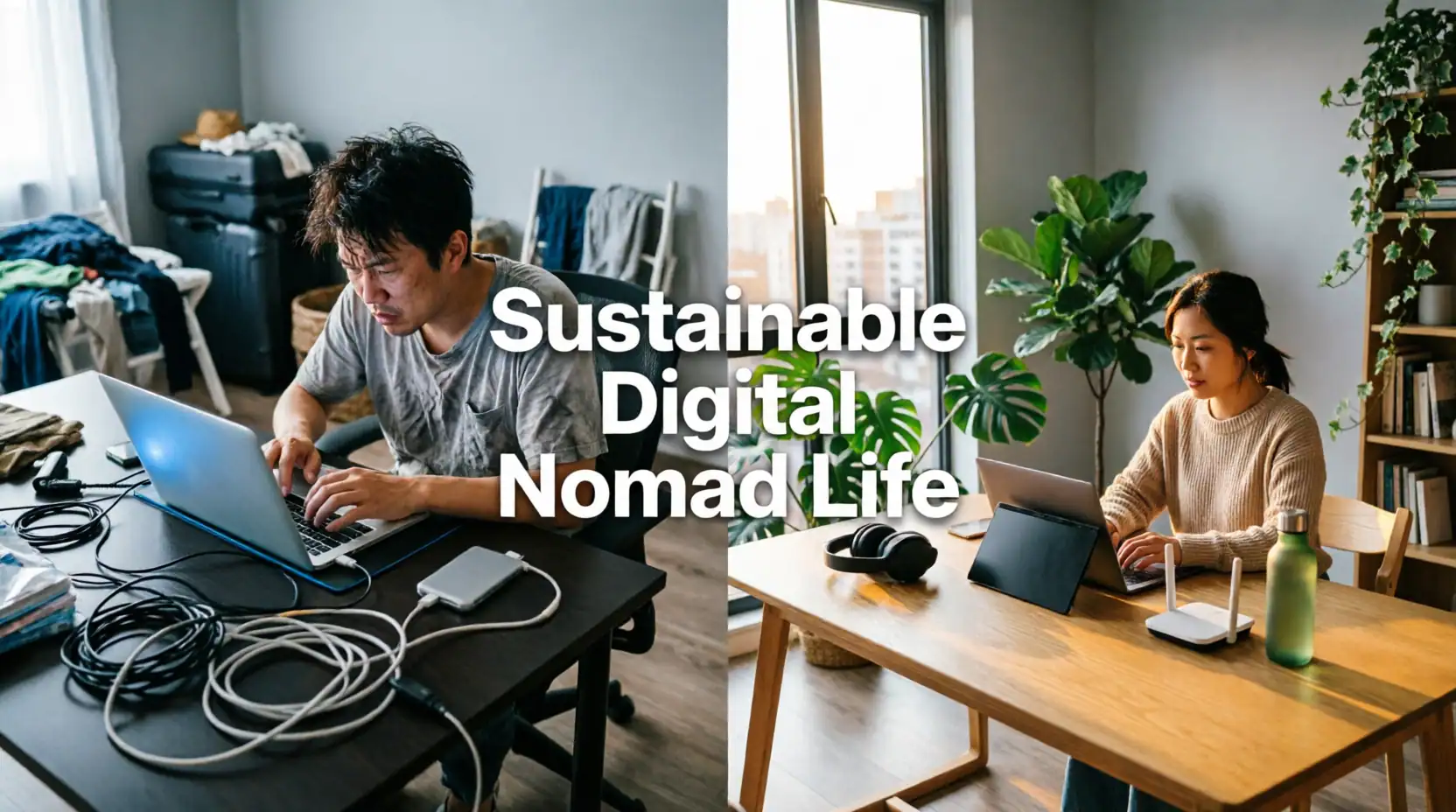
The first few months of digital nomad life are intoxicating. Sunrise yoga on a Bali beach, coworking from a Lisbon café with perfect espresso, weekend trips to hidden waterfalls, and the thrill of building a life unbound by geography. Social media feeds overflow with #vanlife sunsets and #remotework paradise shots. It's easy to believe this is the new normal—that freedom, adventure, and productivity can coexist effortlessly forever.
Then, reality sets in. The honeymoon phase fades. WiFi fails during a critical client call. Loneliness creeps in after the third city change in two months. Burnout emerges from constant decision fatigue about where to eat, sleep, and work. Visa runs become stressful chores. The romanticized vision of perpetual travel collides with the practical demands of sustainable remote work, meaningful relationships, and long-term wellbeing.
This isn't failure—it's evolution. The "tethered drifter" isn't someone who gave up on the nomad dream; it's someone who refined it. Sustainable digital nomadism isn't about constant movement or Instagram-worthy locations. It's about building a life that integrates work, travel, community, and wellbeing in a way that can be maintained for years, not just months.
This comprehensive guide delivers an evidence-based framework for building a sustainable digital nomad life after the honeymoon phase. You'll learn how to recognize and navigate the post-honeymoon reality, establish routines that support productivity without rigidity, build financial and emotional resilience for long-term travel, cultivate meaningful connections across borders, and design a nomad lifestyle that aligns with your values, career goals, and wellbeing needs. Whether you're six months into your journey or five years in and feeling the strain, you'll find practical, compassionate strategies to create a nomad life that lasts.
Understanding the Post-Honeymoon Reality: Why Sustainability Matters
Before building solutions, it's essential to understand why the honeymoon phase ends—and why that's not just normal, but necessary for long-term success.
The Digital Nomad Honeymoon Phase: What It Is and Why It Ends
Characteristics of the Honeymoon Phase:
- Novelty-driven motivation: Every new location feels exciting; exploration fuels energy
- Productivity spikes: Fresh environments boost creativity and focus temporarily
- Social abundance: Easy connections with fellow travelers in hostels and coworking spaces
- Minimal routine: Flexibility feels freeing; structure seems unnecessary
- Financial optimism: Initial budgeting feels manageable; "treating yourself" is frequent
Why It Naturally Fades:
- Hedonic adaptation: Humans adapt to new circumstances; novelty loses its dopamine boost
- Decision fatigue: Constant choices about location, accommodation, food, and logistics deplete mental energy
- Relationship transience: Repeated goodbyes as travelers move on creates emotional exhaustion
- Work-travel tension: Client deadlines don't pause for sunset views; productivity demands structure
- Physical toll: Frequent travel disrupts sleep, nutrition, and exercise routines
Key Insight: The end of the honeymoon phase isn't a sign you're "doing nomad life wrong." It's a signal that your lifestyle needs to evolve from novelty-based to values-based sustainability.
The Cost of Unsustainable Nomadism
| Area | Short-Term "Honeymoon" Approach | Long-Term Sustainability Risk |
|---|---|---|
| Productivity | Work when inspired; chase "perfect" work environments | Inconsistent output; client dissatisfaction; career stagnation |
| Finances | Spend freely on experiences; minimal budget tracking | Depletion of savings; income volatility stress; inability to invest in future |
| Relationships | Connect superficially with many travelers; avoid deep investment | Chronic loneliness; lack of support system; emotional burnout |
| Health | Prioritize adventure over sleep, nutrition, exercise | Weakened immunity; chronic fatigue; mental health challenges |
| Identity | Define self by travel content and location tags | Loss of purpose when novelty fades; existential uncertainty |
Reframing Success: From "More Places" to "Better Life"
Sustainable nomadism shifts the metric of success:
- From: "How many countries can I visit this year?"
- To: "How can I design a life that integrates work, travel, and wellbeing long-term?"
- From: "Is this location Instagram-worthy?"
- To: "Does this location support my productivity, health, and values?"
- From: "How do I meet more people?"
- To: "How do I cultivate meaningful connections that nourish me?"
This reframing isn't about giving up adventure—it's about choosing adventures that align with a life you can sustain and enjoy for years.
Phase 1: Foundation—Building Structure Without Sacrificing Freedom
Sustainability requires structure. The goal isn't rigidity—it's creating flexible frameworks that support your priorities while preserving nomad flexibility.
The "Anchor Routine" Strategy
What It Is: A minimal, portable routine that travels with you regardless of location, providing stability amid change.
Core Components:
- Non-negotiable work blocks:
- Identify your peak productivity hours (e.g., 9 AM-12 PM local time)
- Protect these hours for deep work regardless of location or time zone
- Communicate these blocks clearly to clients and team members
- Daily wellbeing anchors:
- One consistent morning ritual (e.g., 10 minutes of meditation, journaling, or stretching)
- One consistent evening wind-down (e.g., no screens 30 minutes before bed, gratitude practice)
- These anchors require minimal time but provide maximum psychological stability
- Weekly review ritual:
- 30 minutes weekly to assess: What worked? What drained energy? What needs adjustment?
- Use insights to refine next week's plan—flexible planning, not rigid scheduling
Implementation Tips:
- Start small: Choose 1-2 anchors to implement first; add more only when consistent
- Make it portable: Design anchors that work in a hostel, apartment, or co-living space
- Track, don't judge: Use a simple notebook or app to note what's working; adjust without self-criticism
Location Selection: Criteria Beyond Instagram
The Sustainable Nomad Location Framework:
| Category | Key Questions | Why It Matters for Sustainability |
|---|---|---|
| Work infrastructure | Reliable WiFi? Quiet coworking options? Power stability? Time zone alignment with clients? | Productivity depends on infrastructure; unreliable basics create constant stress |
| Cost of living | Does budget allow for savings, healthcare, and emergencies—not just survival? | Financial sustainability requires buffer for unexpected costs and future planning |
| Community potential | Active nomad/expat community? Local connection opportunities? Language accessibility? | Meaningful relationships prevent loneliness and provide practical support |
| Health access | Quality healthcare nearby? Healthy food options? Opportunities for movement/exercise? | Physical and mental health are foundational to long-term nomad viability |
| Visa/legal stability | Clear visa pathway? Reasonable renewal process? Tax implications understood? | Legal uncertainty creates background anxiety that drains cognitive resources |
Practical Application:
- Create a location scorecard using these criteria; rate potential destinations 1-5 in each category
- Prioritize locations scoring 4+ in work infrastructure and health access—non-negotiables for sustainability
- Allow flexibility on "nice-to-have" categories (e.g., beach access, nightlife) based on current season/needs
- Reassess every 3-6 months: Needs evolve; location criteria should too
Slowing Down: The Power of Slow Travel for Sustainability
Why Slow Travel Works:
- Reduced decision fatigue: Staying 1-3 months per location minimizes constant logistics planning
- Deeper connections: Time allows relationships to move beyond surface-level traveler interactions
- Cost efficiency: Monthly rentals often cost less per night than short-term stays; local discounts emerge
- Productivity gains: Familiarity with location reduces cognitive load, freeing mental energy for work
- Cultural integration: Longer stays enable language learning, local friendships, and meaningful experiences
Implementing Slow Travel:
- Minimum stay guideline: Commit to 4-8 weeks minimum per location; adjust based on work demands
- Base + exploration model: Choose one "home base" for 2-3 months; take weekend trips to nearby areas
- Seasonal rhythm: Align location changes with seasons (e.g., escape European winter; enjoy Southeast Asia dry season)
- Permission to stay longer: If a location works well, extend—no need to move just because you "should"
Phase 2: Financial Sustainability—Budgeting for the Long Haul
Financial stress is a leading cause of nomad burnout. Sustainable nomadism requires financial systems that support both present enjoyment and future security.
The Three-Tier Nomad Budget Framework
Tier 1: Survival Budget (Non-Negotiable)
- Covers: Accommodation, food, basic transportation, work infrastructure (WiFi, coworking), health insurance, visa fees
- Goal: Ensure baseline needs are met without dipping into savings
- Strategy: Track meticulously for first 3 months in new location; adjust expectations based on real data
Tier 2: Sustainability Buffer (Essential)
- Covers: Emergency fund contributions (aim for 3-6 months of Tier 1 expenses), retirement savings, professional development, healthcare beyond basics
- Goal: Build resilience against income volatility, health issues, or unexpected travel changes
- Strategy: Automate transfers to savings/investment accounts on income receipt; treat as non-negotiable expense
Tier 3: Enrichment Budget (Flexible)
- Covers: Travel experiences, dining out, hobbies, community events, personal growth
- Goal: Enjoy the nomad lifestyle without compromising Tier 1 or 2
- Strategy: Allocate after Tiers 1 and 2 are funded; adjust based on current priorities and location costs
Budget Tracking Tools for Nomads:
- Apps: YNAB (You Need A Budget), Trail Wallet, or simple spreadsheet with currency conversion
- Method: Weekly 15-minute review; monthly deeper assessment; quarterly strategy adjustment
- Mindset: Budgeting isn't restriction—it's intentional allocation of resources toward what matters most
Income Diversification: Reducing Volatility Risk
Why Diversification Matters:
- Client loss, project delays, or market shifts can disrupt single-income nomads
- Multiple income streams create resilience and reduce anxiety about any single source
- Diversification doesn't require working more hours—just smarter allocation of skills
Practical Diversification Strategies:
| Income Type | Examples | Time Investment | Sustainability Benefit |
|---|---|---|---|
| Core client work | Retainer contracts, ongoing projects with reliable clients | Primary time allocation | Stable baseline income; predictable cash flow |
| Passive/semi-passive | Digital products, affiliate income, content monetization | Upfront creation; minimal maintenance | Income during slow periods; scales without proportional time increase |
| Skill-based side projects | Consulting, workshops, coaching in your expertise area | Flexible; project-based | Leverages existing skills; builds reputation; diversifies client base |
| Community/value-add | Membership communities, paid newsletters, niche resources | Moderate ongoing effort | Builds audience; creates recurring revenue; deepens expertise |
Implementation Tips:
- Start with one diversification stream; master it before adding another
- Align side projects with core skills to minimize context-switching fatigue
- Set clear boundaries: Protect core work time; schedule side projects intentionally
- Track ROI: Not all income streams are worth the time investment; prune what doesn't serve sustainability
Banking and Financial Logistics for Global Life
Essential Financial Infrastructure:
- Multi-currency accounts: Wise (TransferWise), Revolut, or similar to minimize conversion fees and hold multiple currencies
- Emergency access: Keep backup payment methods (second credit card, cash reserve) separate from primary wallet
- Tax strategy: Consult a cross-border tax professional; understand residency rules, double-taxation treaties, and reporting requirements
- Insurance beyond health: Consider equipment insurance, trip interruption coverage, and liability coverage for freelance work
Pro Tips:
- Notify banks of travel plans to avoid frozen cards; use apps that allow instant card freezing/unfreezing
- Keep digital copies of important documents (passport, insurance, contracts) in secure cloud storage
- Build relationships with financial professionals who understand nomad/remote work complexities
Phase 3: Community and Connection—Building Belonging Across Borders
Loneliness is one of the most cited challenges among long-term nomads. Sustainable nomadism requires intentional community building—not just collecting acquaintances, but cultivating relationships that nourish and support.
The Three Layers of Nomad Community
Layer 1: Location-Based Connections (Immediate)
- Where to find: Coworking spaces, nomad meetups, language exchanges, local hobby groups
- Strategy:
- Attend one recurring event weekly (e.g., Tuesday coworking lunch, Thursday language exchange)
- Volunteer for a local cause or skill-share workshop to meet purpose-driven people
- Use apps like Meetup, Nomad List, or InterNations to find relevant gatherings
- Goal: Practical support (WiFi tips, restaurant recs) and casual social connection
Layer 2: Interest-Based Communities (Ongoing)
- Where to find: Online communities around your profession, hobbies, or values (Slack groups, Discord servers, niche forums)
- Strategy:
- Join 2-3 communities aligned with core interests; participate consistently, not passively
- Offer value first: Share resources, answer questions, introduce connections
- Move conversations to video calls or in-person meetups when geographically aligned
- Goal: Deeper connections around shared passions; professional growth; emotional support
Layer 3: Rooted Relationships (Long-Term)
- Where to find: People you intentionally invest in across locations; "nomad family" who reunite in different cities
- Strategy:
- Identify 3-5 people you want to maintain long-term; schedule regular check-ins regardless of location
- Plan intentional reunions: "Let's all meet in Portugal next spring" creates anticipation and continuity
- Embrace asynchronous connection: Voice notes, shared playlists, or collaborative documents maintain bonds across time zones
- Goal: Deep belonging; people who know your story and support your journey long-term
Combating Loneliness: Practical Strategies
Preventive Practices:
- Schedule connection: Treat social time like a work meeting; block calendar time for coffee chats or video calls
- Quality over quantity: One meaningful conversation beats five superficial exchanges
- Be the initiator: Don't wait to be invited; extend invitations to coworking neighbors or meetup attendees
- Embrace local culture: Learning basic phrases in the local language opens doors to authentic connections beyond the nomad bubble
When Loneliness Hits:
- Name it: Acknowledge the feeling without judgment; loneliness is data, not failure
- Reach out: Message a Layer 3 connection; often others feel the same and welcome reconnection
- Shift focus: Engage in a flow activity (writing, coding, creating) to reconnect with purpose
- Seek professional support: Many therapists offer online sessions; mental health is part of sustainability
Navigating Relationship Transience
The Reality: Nomad life involves frequent goodbyes. Sustainable connection requires accepting impermanence without becoming detached.
Healthy Approaches:
- Celebrate the chapter: Acknowledge what a relationship offered, even if it was time-limited
- Stay connected asynchronously: Share updates via voice notes, photos, or collaborative playlists without pressure for immediate response
- Plan future intersections: "Let's aim to overlap in Southeast Asia next year" creates hopeful continuity
- Allow grief: It's okay to feel sad when meaningful connections pause; process emotions without rushing to "fix" them
Phase 4: Health and Wellbeing—Sustaining Body and Mind on the Move
Physical and mental health are non-negotiable foundations of sustainable nomadism. Neglecting wellbeing for the sake of travel inevitably leads to burnout.
Physical Health: Portable Wellness Practices
Nutrition Strategies:
- Master 3-5 simple meals: Identify healthy, easy-to-prepare meals you can make in any kitchen (e.g., grain bowls, stir-fries, omelets)
- Local market ritual: Visit local markets weekly; buy fresh produce to supplement restaurant meals
- Hydration habit: Carry a reusable water bottle; set phone reminders if in dry climates or high-altitude locations
- Supplement wisely: Consider vitamin D (if in low-sun locations), probiotics (for gut health while traveling), and electrolytes (for hydration)
Movement Integration:
- "Exercise snacking": 10-minute movement breaks throughout the day (stretching, walking, bodyweight exercises)
- Location-based activity: Hiking in mountains, swimming near coast, dancing in cultural hubs—align movement with location strengths
- Portable equipment: Resistance bands, jump rope, or yoga mat pack small and enable consistent practice
- Community movement: Join local running groups, yoga classes, or sports leagues to combine fitness with connection
Sleep Optimization:
- Portable sleep kit: Eye mask, earplugs, and familiar pillowcase create consistency across accommodations
- Wind-down ritual: 30 minutes of screen-free time before bed; read, journal, or meditate regardless of location
- Light management: Use blue-light blocking glasses in evenings; seek morning sunlight to regulate circadian rhythm
- Time zone strategy: When crossing multiple time zones, adjust sleep schedule gradually; prioritize rest over productivity during transition
Mental Health: Building Resilience for Nomad Life
Preventive Practices:
- Daily mindfulness: 5-10 minutes of meditation or breathwork to manage stress and increase present-moment awareness
- Gratitude practice: Note 3 things you're grateful for daily; counters negativity bias during challenging travel moments
- Boundaries with work: Define clear work hours; communicate availability to clients; protect personal time
- Digital detox periods: Schedule regular time offline from social media and news to reduce comparison and anxiety
When Struggling:
- Normalize the struggle: Nomad life has hard days; acknowledging difficulty reduces shame and isolation
- Reach for support: Contact a Layer 3 connection, join a nomad mental health group, or seek online therapy
- Reconnect with purpose: Revisit your "why" for nomad life; align daily actions with core values
- Consider a pause: Sometimes sustainability means staying in one place longer, or taking a break from travel to recharge
Healthcare Logistics for Global Living
Essential Preparations:
- Comprehensive health insurance: Choose a plan with global coverage, telehealth options, and clear evacuation protocols (e.g., SafetyWing, Genki, IMG Global)
- Medical records access: Keep digital copies of prescriptions, vaccination records, and key health history
- Local provider research: Before arriving in a new location, identify English-speaking doctors, dentists, and pharmacies
- Preventive care schedule: Schedule annual check-ups, dental cleanings, and vaccinations during stable periods
Mental Health Support:
- Online therapy platforms: BetterHelp, Talkspace, or therapists specializing in expat/nomad issues
- Peer support: Nomad-specific mental health communities (e.g., Nomad Psychology Facebook group)
- Crisis resources: Save international crisis hotlines and telehealth emergency contacts in your phone
Phase 5: Career Growth—Thriving Professionally While Nomadic
Sustainable nomadism requires career strategies that support both location independence and professional growth.
Building a Location-Independent Career
Skill Development for Remote Resilience:
| Skill Category | Why It Matters for Nomads | How to Develop |
|---|---|---|
| Asynchronous communication | Collaborate effectively across time zones without constant meetings | Practice clear written updates; use Loom for video explanations; master project management tools |
| Self-management | Stay productive without external structure or supervision | Experiment with time-blocking, Pomodoro technique, or accountability partnerships |
| Digital tool mastery | Leverage technology to work efficiently from anywhere | Invest time learning key tools (Notion, Slack, Zoom, Figma); create templates for recurring tasks |
| Client boundary setting | Protect work-life balance while delivering exceptional value | Practice clear communication about availability; use contracts that define scope and response times |
| Personal branding | Attract opportunities that align with nomad lifestyle and values | Share authentic nomad work insights; build portfolio showcasing remote collaboration success |
Career Pathways That Support Nomadism:
- Freelancing/consulting: Maximum location flexibility; requires strong self-marketing and client management
- Remote-first companies: Structured remote culture; benefits and stability with location freedom
- Digital product creation: Build once, sell repeatedly; scalable income with flexible time allocation
- Hybrid models: Combine client work, product income, and teaching/coaching for diversified, resilient career
Managing Time Zones and Client Expectations
Proactive Communication Strategies:
- Set clear availability: Share your working hours in client's time zone; use Calendly or similar for scheduling
- Over-communicate proactively: Send brief updates before clients ask; anticipate questions about time zone impacts
- Batch communication: Schedule specific times for email/Slack responses to avoid constant context-switching
- Use async-first approach: Default to written updates, recorded videos, or documented processes before requesting live meetings
Tools for Time Zone Management:
- World clock widgets: Keep client time zones visible on your desktop or phone
- Scheduling tools: Calendly, SavvyCal, or Clockwise that auto-convert time zones for clients
- Async collaboration: Loom for video updates, Notion for documentation, Miro for visual collaboration
Professional Development on the Road
Learning Strategies for Nomads:
- Micro-learning: 15-20 minute daily learning sessions via podcasts, articles, or short courses
- Location-based learning: Leverage local culture for skill development (e.g., language immersion, cultural workshops)
- Virtual conferences and cohorts: Participate in online industry events; join remote-friendly professional communities
- Peer learning: Form mastermind groups with other nomad professionals for accountability and insight sharing
Portfolio Building While Traveling:
- Document your journey: Share insights about remote work, cross-cultural collaboration, or nomad productivity
- Case studies: Turn successful client projects into portfolio pieces highlighting remote collaboration success
- Thought leadership: Write articles, record podcasts, or speak at virtual events about your nomad professional experience
Phase 6: Legal and Logistical Sustainability—Navigating the Practicalities
Long-term nomadism requires attention to legal, tax, and logistical details that enable freedom without constant administrative stress.
Visa Strategy: Beyond Tourist Stays
Understanding Visa Options:
| Visa Type | Best For | Key Considerations | Resources |
|---|---|---|---|
| Digital nomad visas | Remote workers with stable income; 6-12 month stays | Income requirements; tax implications; application complexity | Nomad List, official government immigration sites |
| Freelancer/self-employed visas | Freelancers with client contracts; longer-term residency | Proof of clients/income; local business registration; language requirements | Country-specific immigration portals; expat forums |
| Retirement visas | Those with passive income or savings; often lower income thresholds | Age requirements; proof of funds; healthcare requirements | International Living, country embassy websites |
| Tourist visas + extensions | Shorter stays; flexibility to move; lower barrier to entry | Visa runs may be required; limited work rights; uncertainty | VisaHQ, iVisa, local immigration offices |
Practical Visa Management:
- Track expiration dates: Use a spreadsheet or app to monitor visa deadlines; set reminders 30 days in advance
- Document everything: Keep digital and physical copies of applications, approvals, and entry stamps
- Build relationships: Connect with immigration lawyers or expat communities in frequent destinations for guidance
- Plan buffer time: Allow extra days/weeks for visa processing delays; avoid last-minute stress
Tax Strategy for Global Earners
Foundational Principles:
- Residency vs. source: Understand the difference between tax residency (where you live) and income source (where work is performed)
- Double-taxation treaties: Research agreements between your home country and frequent destinations to avoid paying tax twice
- Professional guidance: Consult a cross-border tax specialist; the cost is an investment in compliance and peace of mind
Practical Steps:
- Track location and income: Maintain detailed records of days spent in each country and income earned during those periods
- Understand thresholds: Many countries have "183-day rules" for tax residency; know the rules for your frequent destinations
- Consider a "home base": Maintaining tax residency in one country (even if rarely visited) can simplify filings
- Plan for retirement: Explore international retirement accounts (e.g., Roth IRA for US citizens) that work across borders
Administrative Systems for Nomad Life
Digital Organization:
- Cloud-first approach: Store documents, photos, and work files in secure cloud storage (Google Drive, Dropbox, Notion)
- Password management: Use a password manager (1Password, Bitwarden) with two-factor authentication for all accounts
- Automate recurring tasks: Set up automatic bill payments, savings transfers, and subscription renewals
Physical Logistics:
- Minimalist packing: Curate a capsule wardrobe and essential gear that works across climates and occasions
- Mail and packages: Use virtual mail services (EarthClass Mail, Traveling Mailbox) or trusted friend/family for physical mail
- Emergency preparedness: Keep copies of passport, insurance, and key contacts in multiple secure locations
Phase 7: Knowing When to Pause, Pivot, or Settle
Sustainability isn't about perpetual motion. Sometimes the most sustainable choice is to slow down, change direction, or establish a home base.
Signs It's Time to Reassess Your Nomad Approach
- Chronic exhaustion: Feeling drained most days despite adequate sleep; travel feels like obligation, not choice
- Work suffering: Missing deadlines, declining quality, or client dissatisfaction due to travel demands
- Relationship strain: Difficulty maintaining connections with family, partners, or close friends due to constant movement
- Loss of purpose: Questioning why you're traveling; feeling adrift rather than intentional
- Financial stress: Budget constantly tight; savings depleting; anxiety about income volatility
Options for Recalibration
Option 1: Slow Down (Same Path, Different Pace)
- Extend stays in favorite locations to 3-6 months
- Reduce travel frequency; focus on depth over breadth
- Build a "home base" apartment in one location while maintaining flexibility to travel
Option 2: Pivot Direction (New Focus, Same Freedom)
- Shift career focus to better align with nomad lifestyle (e.g., from client services to product creation)
- Change travel style: from city-hopping to nature-immersion, or vice versa
- Adjust community focus: from nomad-centric to local-integration or hybrid
Option 3: Establish a Home Base (Rooted Flexibility)
- Choose a location to call "home" for 6-12 months at a time
- Use this base for deep work, relationship building, and administrative tasks
- Travel intentionally from this base for specific projects, seasons, or experiences
Key Principle: Sustainability isn't about sticking to one path forever. It's about regularly checking in with yourself and adjusting your approach to align with your evolving needs, values, and circumstances.
Frequently Asked Questions
How do I know if I'm ready for long-term nomad life?
Ask yourself these reflective questions: - Work: Can I maintain consistent productivity without external structure? Do I have reliable income streams? - Finances: Do I have 3-6 months of expenses saved? Can I budget across currencies and unexpected costs? - Relationships: Am I comfortable with transient connections? Do I have strategies for maintaining important relationships? - Health: Can I maintain healthy habits while traveling? Do I have access to healthcare in potential destinations? - Mindset: Am I seeking nomad life for freedom and growth, or escaping something? (Both are valid, but require different support) If you're unsure, start with a 3-month trial. Treat it as an experiment, not a permanent commitment. Reflect honestly on what worked and what didn't.
How do I handle homesickness or missing "normal" life?
Homesickness is normal—and manageable: - Name the feeling: Acknowledge homesickness without judgment; it's data about what you value - Recreate anchors: Bring small pieces of "home" (favorite tea, photos, playlist) to create comfort anywhere - Stay connected intentionally: Schedule regular video calls with loved ones; share experiences, not just updates - Create new rituals: Build routines in your current location that feel nourishing and familiar - Allow flexibility: It's okay to return "home" for a visit, or pause nomad life temporarily. Sustainability includes honoring your emotional needs Remember: Missing aspects of "normal" life doesn't mean you failed at nomadism. It means you're human.
How do I balance work and travel without burning out?
Prevent burnout with intentional boundaries: - Protect work time: Define clear work hours; communicate them to clients and travel companions - Schedule rest: Block time for rest, exploration, and connection—treat these as non-negotiable appointments - Practice "good enough": Not every day needs to be productive or Instagram-worthy; allow ordinary moments - Monitor energy: Track what drains vs. replenishes you; adjust travel pace and work load accordingly - Take real breaks: Schedule periods with no work obligations to fully recharge Burnout isn't a badge of honor. Sustainable nomadism requires protecting your energy as fiercely as your passport.
What if my career requires more stability than nomad life allows?
Flexibility exists on a spectrum: - Hybrid approach: Maintain a home base while traveling 3-6 months per year - Seasonal nomadism: Travel intensively during slower work periods; settle during peak seasons - Role adjustment: Negotiate remote-friendly responsibilities with your employer; propose pilot remote periods - Skill pivot: Develop location-independent skills gradually while maintaining current role Your career and nomad life can coexist with creativity and communication. The goal isn't perfection—it's finding a balance that serves both your professional growth and personal freedom.
How do I handle the pressure to "make the most" of every location?
Release the pressure with perspective: - Redefine "making the most": It's not about checking every landmark; it's about meaningful experiences that align with your values - Embrace JOMO: Joy of Missing Out—choose depth over breadth; one meaningful connection over ten superficial tours - Practice presence: Focus on where you are right now, not the next destination or the "perfect" experience - Set intentions, not itineraries: "I want to feel connected to local culture" vs. "I must visit these 10 sites" The most sustainable nomad life isn't about maximizing experiences—it's about curating a life that feels authentic, nourishing, and true to who you are.
Conclusion: Building a Life That Lasts
The tethered drifter isn't someone who failed at the nomad dream. They're someone who refined it. They understand that true freedom isn't about endless movement—it's about designing a life that integrates work, travel, community, and wellbeing in a way that can be sustained for the long haul.
Sustainable digital nomadism isn't less exciting than the honeymoon phase. It's more meaningful. It's choosing locations that support your productivity, not just your Instagram feed. It's building routines that protect your energy, not just chasing novelty. It's cultivating relationships that nourish your soul, not just collecting acquaintances. It's creating financial systems that provide security, not just funding the next adventure.
This journey isn't about perfection. It's about progress—small, intentional adjustments that compound into a life you can thrive in for years, not just months. It's about listening to your needs, honoring your limits, and having the courage to pivot when something isn't serving you.
Key takeaways for building a sustainable digital nomad life:
- Structure enables freedom: Anchor routines and flexible frameworks create stability without rigidity
- Financial sustainability is foundational: Budget intentionally, diversify income, and plan for the long term
- Community is non-negotiable: Invest in layered relationships that provide connection across borders
- Health is your greatest asset: Prioritize physical and mental wellbeing as the foundation of all other goals
- Career growth requires intention: Develop remote-resilient skills and communicate proactively across time zones
- Legal logistics enable freedom: Master visa strategy, tax basics, and administrative systems to reduce background stress
- Flexibility includes pausing: Sustainability means knowing when to slow down, pivot, or establish roots
Your nomad journey is uniquely yours. There's no single "right" way to build a sustainable life on the move. What matters is that your approach aligns with your values, supports your wellbeing, and allows you to thrive—not just survive—across the beautiful, complex reality of long-term remote work and travel.
Start today. Choose one action from this guide to implement this week: perhaps establishing one anchor routine, reviewing your budget framework, or reaching out to nurture a Layer 3 connection. Small, intentional steps compound into a life that lasts.
The world is vast, and your journey is just beginning. Build it with intention, compassion, and the wisdom that true freedom isn't about going everywhere—it's about creating a life you love, wherever you are.
Here's to your sustainable, fulfilling, and authentically nomadic life.
📖 আরও পড়ুন: Trending Now
- 🔗 How to Use Agentic AI to Automate Your Daily Business Operations in 2026
- 🔗 Neuro-Relaxation Wearables: Can They Cure Anxiety?
- 🔗 VNS Gadgets: The New Wellness Essential
- 🔗 ২০২৬ সালে এজেন্টিক এআই ব্যবহার করে আপনার প্রতিদিনের ব্যবসায়িক কার্যক্রম কীভাবে অটোমেট করবেন
- 🔗 Digital Nomad Guide 2026: Work and Travel Smart