You've just finished your hair care routine: shampoo, conditioner, maybe even a deep conditioning mask. You've followed all the instructions, used quality products, and waited the recommended time. Yet when you look in the mirror, your hair still looks lackluster, flat, and dull. If this frustrating scenario sounds familiar, you're not alone. Millions of people struggle with dull hair despite regular conditioning, and the reasons are more complex than simply not conditioning enough.
The disconnect between conditioning and shine reveals important truths about hair health, product formulation, and the multiple factors that contribute to that coveted glossy appearance. Understanding why your hair remains dull despite conditioning is the first step toward achieving the luminous, healthy-looking hair you desire.
This comprehensive guide explores the science behind hair shine, identifies the hidden culprits that keep your hair looking dull despite conditioning, and provides evidence-based solutions to restore your hair's natural luster. Whether you're dealing with product buildup, hard water damage, cuticle damage, or underlying health issues, you'll find actionable strategies to transform your dull hair into the shiny, vibrant mane you've been wanting.
The Science of Hair Shine: What Creates that Glossy Look
Before addressing why hair looks dull, it's essential to understand what creates shine in the first place. Hair shine is not just about moisture—it's about light reflection, which depends on several structural and surface factors.
The Cuticle: Your Hair's Reflective Surface
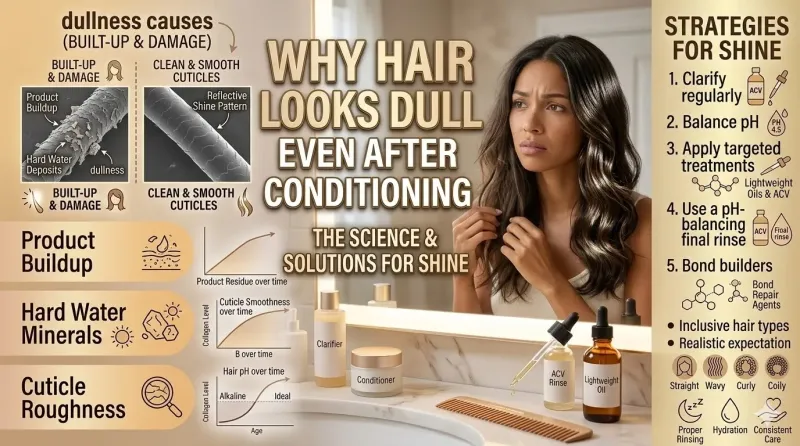
The outermost layer of your hair shaft, called the cuticle, is responsible for shine. Think of it like shingles on a roof:
- Healthy cuticles: Lie flat and smooth, creating a reflective surface that bounces light uniformly, creating shine
- Damaged cuticles: Are raised, rough, or missing, scattering light in different directions, creating a dull appearance
When cuticles lie flat and smooth, they act like tiny mirrors, reflecting light consistently. This is why healthy hair appears shiny. When cuticles are damaged, lifted, or uneven, light scatters instead of reflecting, resulting in dullness.
Factors That Create Shine
1. Smooth Cuticle Surface: The flatter and smoother the cuticle, the more light it reflects.
2. Natural Oils (Sebum): Your scalp produces natural oils that coat the hair shaft, adding shine and protecting the cuticle.
3. Hair Density and Thickness: Thicker, denser hair reflects more light overall.
4. Hair Color: Darker hair naturally appears shinier because it absorbs more light and reflects it more dramatically.
5. Moisture Balance: Properly hydrated hair has better light reflection, but too much moisture can actually reduce shine.
Why Conditioning Alone Isn't Enough
Conditioners primarily work by:
- Adding moisture to the hair shaft
- Temporarily smoothing the cuticle
- Reducing friction between hair strands
- Providing detangling benefits
However, conditioners cannot:
- Repair severely damaged cuticles
- Remove product buildup or mineral deposits
- Override the effects of hard water
- Compensate for underlying health issues
- Fix mechanical damage from styling
This is why you can condition religiously and still have dull hair—the underlying issues preventing shine remain unaddressed.
Hidden Causes of Dull Hair Despite Conditioning
Multiple factors can keep your hair looking dull even with regular conditioning. Identifying which applies to you is crucial for finding the right solution.
1. Product Buildup: The Invisible Barrier
The Problem: Over time, styling products, silicones, oils, and even some conditioners leave residues on your hair. This buildup creates a barrier that:
- Prevents moisture from penetrating the hair shaft
- Weighs hair down, making it look flat
- Creates a dull, coated appearance
- Prevents conditioners from working effectively
Signs You Have Buildup:
- Hair feels heavy or greasy soon after washing
- Products don't seem to work as well as they used to
- Hair looks dull despite using good products
- Hair feels coated or waxy
Solution: Use a clarifying shampoo once every 1-2 weeks to remove buildup. Look for shampoos containing:
- Sulfates (for deep cleansing)
- Apple cider vinegar
- Chelating agents (EDTA)
- Charcoal or clay
2. Hard Water Damage: The Mineral Menace
The Problem: Hard water contains high levels of minerals like calcium, magnesium, and iron. These minerals:
- Build up on the hair shaft, creating a rough, dull surface
- Prevent conditioners from penetrating effectively
- React with shampoo, creating a film on hair
- Make hair feel dry, brittle, and straw-like
- Strip natural oils, leaving hair dull
Signs of Hard Water Damage:
- Hair feels dry despite conditioning
- Mineral deposits (white or greenish tint on blonde hair, orange on light hair)
- Hair feels rough or tangled
- Difficulty lathering shampoo
- Scale buildup on shower fixtures
Solutions:
- Install a shower filter: Removes minerals from water
- Use chelating shampoos: Specifically designed to remove mineral buildup
- Apple cider vinegar rinse: Mix 1-2 tablespoons ACV with 1 cup water, use monthly
- Clarifying treatments: Remove mineral deposits
- Bottled water rinse: Final rinse with distilled or bottled water
3. Cuticle Damage: Beyond Repair
The Problem: Once the cuticle is severely damaged, conditioners can only temporarily smooth it. Common causes include:
- Heat styling: Flat irons, curling irons, blow dryers
- Chemical treatments: Coloring, bleaching, perming, relaxing
- Mechanical damage: Rough brushing, tight hairstyles, towel drying
- Environmental damage: Sun exposure, wind, pollution
- Over-washing: Strips natural oils
Signs of Cuticle Damage:
- Hair feels rough or coarse
- Excessive tangling
- Frizz and flyaways
- Brittle, breaking hair
- Dull appearance despite products
Solutions:
- Protein treatments: Temporarily fill in gaps in damaged cuticles
- Heat protectant: Always use before heat styling
- Lower heat settings: Keep tools below 350°F (180°C)
- Reduce chemical treatments: Space out coloring/bleaching
- Gentle handling: Use wide-tooth comb, microfiber towel
- Regular trims: Remove damaged ends every 6-8 weeks
- Silk pillowcase: Reduces friction while sleeping
4. Over-Conditioning: Too Much of a Good Thing
The Problem: Yes, you can condition too much. Over-conditioning leads to:
- Moisture overload: Hair becomes overly soft, mushy, and limp
- Product buildup: Conditioner residues coat the hair
- Reduced volume: Hair looks flat and lifeless
- Poor light reflection: Overly soft hair doesn't reflect light well
Signs of Over-Conditioning:
- Hair feels greasy or heavy even after washing
- Lack of volume and body
- Hair feels overly soft or mushy when wet
- Difficulty holding style
- Dull, limp appearance
Solutions:
- Clarify regularly: Remove excess conditioner buildup
- Reduce conditioning frequency: Condition every other wash or less
- Apply conditioner correctly: Focus on mid-lengths to ends, avoid roots
- Rinse thoroughly: Ensure no residue remains
- Use lighter products: Switch to lightweight conditioners or leave-ins
- Balance with protein: Use protein treatments to strengthen hair
5. Wrong Products for Your Hair Type
The Problem: Using products formulated for different hair types can leave hair dull:
- Heavy products on fine hair: Weigh hair down, create flat appearance
- Light products on thick/coarse hair: Don't provide enough moisture or smoothing
- Wrong pH balance: Disrupts cuticle alignment
- Incompatible ingredients: Some ingredients don't work well together
Solutions:
- Identify your hair type: Fine, medium, coarse, curly, straight, etc.
- Choose appropriate products: Match products to your specific hair type
- Check pH levels: Ideal hair product pH is 4.5-5.5
- Avoid ingredient conflicts: Don't mix certain actives
6. Underlying Health Issues
The Problem: Sometimes dull hair signals internal health issues:
- Nutritional deficiencies: Iron, vitamin D, B vitamins, protein
- Thyroid disorders: Hypothyroidism causes dry, dull hair
- Hormonal imbalances: Affect sebum production and hair health
- Dehydration: Affects overall hair moisture
- Stress: Chronic stress affects hair health
Solutions:
- Blood work: Check for deficiencies and thyroid function
- Balanced diet: Ensure adequate protein, healthy fats, vitamins
- Supplementation: Address specific deficiencies
- Hydration: Drink adequate water
- Stress management: Exercise, meditation, adequate sleep
- Medical consultation: Address underlying conditions
7. Environmental Factors
The Problem: Environmental aggressors damage hair and reduce shine:
- UV radiation: Damages cuticle and protein structure
- Pollution: Particulate matter coats hair shaft
- Humidity: Causes frizz and cuticle lifting
- Chlorine/salt water: Strips natural oils, causes damage
- Temperature extremes: Hot or cold weather stresses hair
Solutions:
- UV protection: Use hair products with SPF or wear hats
- Protective styles: Braids, buns in harsh conditions
- Pre-swim protection: Wet hair and apply conditioner before swimming
- Antioxidant products: Combat environmental damage
- Regular cleansing: Remove pollution buildup
Advanced Solutions for Restoring Shine
Once you've identified and addressed the underlying causes, these advanced treatments can help restore your hair's natural shine.
Professional Treatments
1. Gloss/Glaze Treatments:
- What it does: Deposits color molecules that smooth cuticle and add shine
- Duration: 4-6 weeks
- Best for: All hair types, especially color-treated hair
- Cost: $50-150
2. Keratin Treatments:
- What it does: Infuses keratin protein to smooth cuticle and add shine
- Duration: 3-5 months
- Best for: Frizzy, coarse, or damaged hair
- Cost: $200-500
3. Olaplex or Bond-Building Treatments:
- What it does: Repairs broken disulfide bonds in hair structure
- Duration: Cumulative improvement
- Best for: Chemically damaged or bleached hair
- Cost: $50-100 per treatment
4. Deep Conditioning Masks:
- What it does: Intensive moisture and nutrient delivery
- Frequency: Weekly or bi-weekly
- Best for: Dry, damaged, or dull hair
- Cost: $10-50 (at-home) or $50-100 (salon)
At-Home Shine-Boosting Techniques
1. Cold Water Rinse:
- How: Final rinse with cool/cold water
- Why: Seals cuticle, increases light reflection
- Tip: Don't make it too cold—just cooler than your wash temperature
2. Apple Cider Vinegar Rinse:
- Recipe: 1-2 tablespoons ACV in 1 cup water
- How: Use after shampooing, before conditioning
- Why: Removes buildup, balances pH, smooths cuticle
- Frequency: Once weekly or bi-weekly
3. Natural Oil Treatments:
- Best oils: Argan, jojoba, coconut, almond
- How: Apply small amount to damp or dry hair
- Why: Adds shine, seals cuticle, prevents moisture loss
- Caution: Use sparingly to avoid greasiness
4. Silk or Satin Pillowcase:
- Why: Reduces friction, prevents cuticle damage
- Benefit: Hair stays smoother and shinier
- Alternative: Silk/satin bonnet or scarf
5. Proper Drying Techniques:
- Microfiber towel: Less friction than regular towel
- Gentle blotting: Don't rub vigorously
- Air dry when possible: Less heat damage
- Heat protectant: Always use before heat styling
Product Recommendations by Hair Concern
For Product Buildup
Clarifying Shampoos:
- Neutrogena Anti-Residue Shampoo
- Malibu C Hard Water Wellness Shampoo
- Ouai Detox Shampoo
- Briogeo Scalp Revival Charcoal + Coconut Oil Shampoo
For Hard Water Damage
Chelating Shampoos:
- Malibu C Hard Water Wellness Shampoo
- R+Co Sunset Blvd Blonde Shampoo
- Christophe Robin Purifying Shampoo with Juniper
Shower Filters:
- AquaBliss High Output Shower Filter
- Jolie Filtered Showerhead
- Culligan Handheld Shower Filter
For Cuticle Damage
Protein Treatments:
- Olaplex No. 3 Hair Perfector
- Briogeo Don't Despair, Repair! Deep Conditioning Mask
- Schwarzkopf Professional BC Bonacure Fiber Force Treatment
Leave-In Conditioners:
- It's a 10 Miracle Leave-In Product
- Ouai Leave-In Conditioner
- Living Proof Restore Perfecting Spray
For Adding Shine
Shine Serums:
- Moroccanoil Treatment
- OGX Renewing Argan Oil of Morocco
- John Frieda Frizz Ease Extra Strength Serum
- Bumble and bumble Hairdresser's Invisible Oil
Gloss Treatments:
- Christophe Robin Shade Variation Care
- Rita Hazan Ultimate Shine Gloss
- John Frieda Luminous Glaze Clear Shine Gloss
Creating Your Shine-Restoration Routine
Weekly Schedule Example
Week 1-2 (Intensive Phase):
- Day 1: Clarifying shampoo + deep conditioning mask
- Day 3: Regular shampoo + conditioner + leave-in
- Day 5: Co-wash (conditioner-only wash) or gentle shampoo
- Day 7: Apple cider vinegar rinse + protein treatment
Week 3-4 (Maintenance Phase):
- Day 1: Regular shampoo + conditioner
- Day 3: Co-wash or gentle shampoo
- Day 5: Regular shampoo + conditioner + shine serum
- Day 7: Deep conditioning mask (optional)
Daily Habits for Lasting Shine
- Morning: Apply small amount of shine serum to damp or dry hair
- Throughout day: Avoid touching hair excessively
- Before bed: Brush gently with natural bristle brush
- Sleep: Use silk/satin pillowcase
- Before styling: Always apply heat protectant
Nutrition for Shiny Hair
Internal health directly impacts hair shine. Ensure you're getting adequate:
Essential Nutrients
Protein:
- Why: Hair is made of keratin (protein)
- Sources: Eggs, fish, lean meat, legumes, nuts
- Amount: 0.8-1g per kg body weight
Omega-3 Fatty Acids:
- Why: Nourish hair, add shine, reduce inflammation
- Sources: Fatty fish, flaxseeds, chia seeds, walnuts
- Amount: 250-500mg EPA+DHA daily
Biotin (Vitamin B7):
- Why: Supports keratin production
- Sources: Eggs, almonds, sweet potatoes, spinach
- Amount: 30-100mcg daily
Vitamin E:
- Why: Antioxidant protection, improves scalp circulation
- Sources: Nuts, seeds, spinach, avocados
- Amount: 15mg daily
Vitamin C:
- Why: Collagen production, iron absorption
- Sources: Citrus fruits, berries, peppers, broccoli
- Amount: 75-90mg daily
Iron:
- Why: Prevents hair loss, supports oxygen delivery
- Sources: Red meat, spinach, lentils, fortified cereals
- Amount: 8-18mg daily (varies by age/gender)
Zinc:
- Why: Supports hair tissue growth and repair
- Sources: Oysters, beef, pumpkin seeds, lentils
- Amount: 8-11mg daily
Frequently Asked Questions
How long does it take to restore shine to dull hair?
Timeline varies based on the cause:
- Product buildup: 1-2 weeks with clarifying treatments
- Hard water damage: 2-4 weeks with chelating treatments
- Mild cuticle damage: 4-8 weeks with proper care
- Severe damage: 3-6 months or longer; may require trimming damaged ends
- Nutritional deficiencies: 2-3 months after correcting deficiency
Consistency is key—results require ongoing maintenance.
Can damaged hair ever be truly shiny again?
It depends on the level of damage:
- Mild to moderate damage: Yes, with proper care, treatments, and time
- Severe damage: Shine can be improved but may not return to original state; trimming damaged portions is often necessary
- Prevention: Once restored, maintain with protective practices
Is it possible to have too much shine?
Not really, but products can make hair look greasy rather than shiny. The difference:
- Healthy shine: Reflects light evenly, hair feels smooth
- Greasy appearance: Hair looks oily, feels heavy, lacks volume
If hair looks greasy, you're likely using too much product or the wrong products for your hair type.
Why does my hair look shiny in the salon but dull at home?
Several factors:
- Professional products: Higher quality, better formulations
- Professional techniques: Proper application, heat styling
- Hard water at home: Different water quality
- Product buildup: Accumulates between salon visits
- Styling tools: Professional tools vs. home tools
Solution: Ask your stylist what products and techniques they use, and consider investing in quality tools and products.
Should I stop using conditioner if my hair looks dull?
No, but you may need to:
- Switch to a different conditioner (lighter formula)
- Reduce frequency of conditioning
- Apply conditioner only to mid-lengths and ends
- Rinse more thoroughly
- Clarify regularly to remove buildup
Conditioner is essential for hair health, but using it correctly is key.
Conclusion: Your Path to Shinier Hair
Dull hair despite conditioning is frustrating, but it's almost always solvable once you identify the underlying cause. Whether it's product buildup, hard water damage, cuticle damage, over-conditioning, wrong products, health issues, or environmental factors, there are effective solutions available.
Key Takeaways:
- Identify the cause: Don't just add more conditioner—address the root issue
- Clarify regularly: Remove buildup that prevents shine
- Protect your hair: Minimize heat, chemical, and environmental damage
- Use the right products: Match products to your hair type and concerns
- Be patient: Restoring shine takes time and consistency
- Nourish from within: Nutrition and overall health matter
- Maintain results: Shine requires ongoing care, not just a one-time fix
Remember, healthy, shiny hair is a reflection of overall hair health. By addressing the underlying causes of dullness and implementing a comprehensive care routine, you can achieve the luminous, vibrant hair you've been wanting. Start with one or two changes, be consistent, and gradually build your shine-restoration routine. Your hair will thank you.
The journey to shinier hair begins with understanding why it looks dull in the first place. Now that you have the knowledge and tools, it's time to take action. Your shiniest hair is waiting.