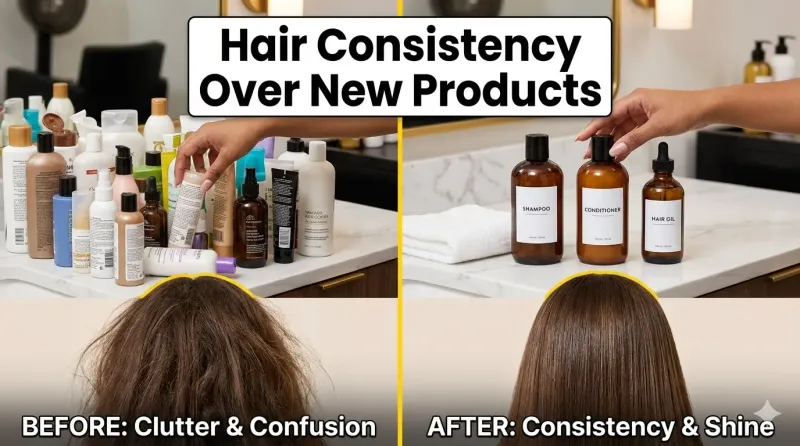
In the age of social media beauty trends, viral hair products, and endless "holy grail" recommendations, it's tempting to believe that the next product you try will finally transform your hair. You buy the trending serum, switch shampoos monthly, layer on the latest mask, and yet... your hair still feels dry, looks dull, or won't grow past a certain length. The frustrating truth? Your hair doesn't need more products—it needs consistency with the right ones.
The cycle of constantly switching hair products is more common than you might think. A new influencer recommendation, a flashy advertisement, or a friend's glowing review can send us rushing to buy the latest miracle product. But here's what the beauty industry rarely tells you: hair doesn't respond to products overnight, and constantly changing your routine prevents any product from having the time it needs to work effectively.
This comprehensive, science-backed guide explores why consistency matters far more than novelty when it comes to hair health. You'll discover the biological reasons hair needs time to respond to products, understand realistic timelines for seeing results, learn to identify when a product truly isn't working versus when you're just being impatient, and find practical strategies to build a consistent routine that actually delivers the healthy, beautiful hair you're seeking. Whether you're struggling with damage, slow growth, dryness, or simply feeling overwhelmed by product choices, you'll find evidence-based insights to help you break the product-hopping cycle and achieve lasting results.
The Science: How Hair Responds to Products Over Time
To understand why consistency matters, we must first examine how hair actually interacts with topical products and why immediate results are rarely realistic.
Hair Structure and Product Absorption
The Hair Shaft Is Not Living Tissue:
- Unlike skin, the visible part of your hair (the shaft) is composed of dead keratinized cells
- Products cannot "repair" damaged hair shafts—they can only coat, protect, or temporarily improve appearance
- Real improvement comes from supporting the living hair follicle beneath the scalp, which takes time
How Products Actually Work:
- Surface-level products: Shampoos, conditioners, and styling products work on the hair cuticle; effects are immediate but temporary
- Scalp treatments: Serums and treatments targeting the follicle require weeks to months to influence new hair growth
- Protein/moisture treatments: Need repeated application to build cumulative benefits in hair structure
The Adaptation Period:
- Hair and scalp need time to adjust to new formulations
- Initial reactions (good or bad) may not reflect long-term efficacy
- Consistent use allows products to work synergistically with your hair's natural biology
The Hair Growth Cycle and Product Efficacy
Understanding the hair growth cycle explains why patience is non-negotiable:
Three Phases of Hair Growth:
- Anagen (Growth Phase): Lasts 2-7 years; this is when products targeting growth can influence new hair
- Catagen (Transition Phase): 2-3 weeks; hair stops growing and follicle shrinks
- Telogen (Resting Phase): 3 months; hair sheds and follicle rests before new growth begins
Why This Matters for Products:
- Any product claiming to affect hair growth must influence the anagen phase
- Since only 85-90% of hairs are in anagen at any time, results take months to become visible
- Switching products before completing a full growth cycle prevents you from seeing true efficacy
Cumulative Benefits vs. Immediate Effects
Immediate Effects (What You See Right Away):
- Shine from silicones or oils coating the cuticle
- Softness from conditioners smoothing the surface
- Volume from styling products lifting roots
- Limitation: These effects wash out or wear off; they don't improve hair health long-term
Cumulative Benefits (What Develops Over Time):
- Reduced breakage from consistent protein or bond-building treatments
- Improved moisture retention from regular use of humectants and emollients
- Healthier scalp environment from consistent use of targeted treatments
- Stronger new growth from scalp serums used consistently over months
- Key Point: These benefits require weeks to months of consistent use to manifest
Why Product-Hopping Undermines Hair Health
Constantly switching products doesn't just waste money—it can actively harm your hair and prevent progress.
1. Preventing Products from Working
The Timeline Problem:
- Most hair products need 4-12 weeks to show measurable results
- Switching before this window closes means you never know if a product would have worked
- Example: A growth serum may need 3 months to show new baby hairs; switching at 6 weeks means you'll never see results
The Adaptation Problem:
- Scalp and hair may initially react negatively to a new product as they adjust
- What feels like "not working" at week 2 might resolve by week 6
- Switching during the adaptation phase prevents products from reaching their potential
2. Creating Confusion About What Works
The Attribution Problem:
- When you use multiple new products simultaneously, you can't identify which one is helping or harming
- Good results might be attributed to the wrong product; bad results might cause you to abandon something that was actually working
- Example: If you start a new shampoo, conditioner, and serum all at once and see improvement, which one deserves credit?
The Baseline Problem:
- Without a consistent routine, you lose your baseline for comparison
- You can't tell if hair is improving, staying the same, or getting worse
- Consistency creates a stable foundation for measuring progress
3. Overwhelming and Damaging Hair
Ingredient Overload:
- Each product introduces new ingredients, preservatives, and potential irritants
- Frequent switching increases cumulative exposure to potential sensitizers
- Result: Increased risk of scalp irritation, allergic reactions, or product buildup
Conflicting Formulations:
- Some ingredients don't work well together (e.g., certain proteins with certain oils)
- Constantly changing products increases the chance of incompatible combinations
- Result: Reduced efficacy, buildup, or unexpected texture issues
Barrier Disruption:
- Frequent changes in cleansing products can disrupt scalp microbiome and skin barrier
- Result: Increased sensitivity, dryness, or oiliness as scalp struggles to adapt
4. Psychological and Financial Costs
The "Grass Is Greener" Trap:
- Constantly seeking the "perfect" product creates dissatisfaction with what you have
- Results in chronic disappointment and wasted money
- Prevents you from appreciating and optimizing your current routine
Financial Impact:
- Average hair product: $15-50
- Trying 3-4 new products monthly: $180-600/year
- Most partially-used products end up discarded: significant waste
- Money spent on experimentation could be invested in quality staples
Realistic Timelines: When to Expect Results
Understanding realistic timelines helps you stick with products long enough to see if they work.
By Product Type
Shampoos and Conditioners:
- Immediate effects: Cleanliness, softness, manageability (after first use)
- Short-term (2-4 weeks): Improved texture, reduced frizz, better detangling
- Long-term (8-12 weeks): Cumulative benefits like reduced breakage, improved shine, healthier scalp
- When to reassess: If no improvement in texture or manageability after 4-6 weeks of consistent use
Scalp Treatments and Growth Serums:
- Immediate effects: Scalp comfort, reduced itching (if product addresses these)
- Short-term (4-8 weeks): Reduced shedding, improved scalp health
- Long-term (3-6 months): Visible new growth, increased hair density, reduced thinning
- When to reassess: If no reduction in shedding after 8 weeks, or no new growth after 4-6 months
Protein and Bond-Building Treatments:
- Immediate effects: Temporary strength, reduced breakage during styling
- Short-term (2-4 weeks): Improved elasticity, reduced snap-off
- Long-term (6-12 weeks): Cumulative strengthening, less overall breakage, longer retained length
- When to reassess: If breakage doesn't decrease after 4-6 weeks of regular use
Moisture and Hydration Products:
- Immediate effects: Softness, reduced static, improved manageability
- Short-term (2-4 weeks): Improved moisture retention, less dryness between washes
- Long-term (4-8 weeks): Reduced breakage from dehydration, improved elasticity
- When to reassess: If hair still feels dry or brittle after 4 weeks of consistent use
Color-Treated or Chemically Processed Hair Products:
- Immediate effects: Improved color vibrancy, reduced brassiness
- Short-term (2-4 weeks): Extended color life, reduced fade
- Long-term (8-12 weeks): Cumulative protection, less damage from chemical processing
- When to reassess: If color fades faster than expected or damage increases after 4-6 weeks
Factors That Influence Timeline
Hair Type and Condition:
- Severely damaged hair may show improvement faster initially (obvious problems are easier to fix)
- Subtle concerns (slight dryness, minor thinning) take longer to show measurable change
- Curly or coily hair may take longer to show moisture benefits due to slower product distribution
Consistency of Use:
- Using a product sporadically extends the timeline for results
- Daily or regular use as directed accelerates visible benefits
- Skipping applications or inconsistent technique reduces efficacy
Overall Hair Health and Lifestyle:
- Nutrition, stress, sleep, and hormonal health affect how quickly hair responds
- Addressing internal factors alongside topical products accelerates results
- Ignoring lifestyle factors can slow or prevent progress regardless of product quality
Signs You're Product-Hopping vs. Being Consistent
Use this self-assessment to identify whether your approach supports or undermines hair health.
Red Flags of Product-Hopping
Behavioral Signs:
- You have 10+ partially-used hair products in your bathroom
- You buy a new product every time you see a positive review or ad
- You switch products after 1-2 uses if you don't see immediate results
- You're constantly researching "the next best thing" instead of optimizing your current routine
- You feel anxious or dissatisfied with your current products, even when they're working
Results-Based Signs:
- Your hair feels different every week but never consistently better
- You can't identify which products actually help because you change them too frequently
- You experience frequent scalp irritation or unexpected reactions
- You spend more money on hair products than you do on groceries or other essentials
- You feel overwhelmed by choices rather than confident in your routine
Green Flags of Consistent Care
Behavioral Signs:
- You have a core routine of 3-5 products you use consistently
- You give new products at least 4-6 weeks before evaluating efficacy
- You introduce one new product at a time to isolate effects
- You track your hair's progress with photos or notes
- You feel confident and satisfied with your routine most of the time
Results-Based Signs:
- You can identify which products specifically help your hair and why
- Your hair shows gradual, cumulative improvement over months
- You experience fewer unexpected reactions or negative surprises
- You spend money strategically on replenishing staples rather than experimenting
- You feel empowered and knowledgeable about your hair care
How to Build a Consistent Hair Care Routine That Works
Creating consistency doesn't mean never trying new products—it means being strategic and patient.
Step 1: Audit and Simplify
Take Inventory:
- Gather all your current hair products
- Note which ones you actually use regularly vs. those collecting dust
- Identify which products have genuinely helped vs. those that haven't
Define Your Core Needs:
- What are your top 1-3 hair concerns? (e.g., dryness, breakage, slow growth)
- What does your hair actually need, not just what sounds appealing?
- Focus on addressing primary concerns before adding extras
Build Your Core Routine:
- Cleanser: One shampoo suited to your scalp type and hair needs
- Conditioner: One conditioner matched to your hair texture and concerns
- Treatment: One targeted product for your primary concern (growth serum, protein treatment, etc.)
- Styler/Protectant: One leave-in or heat protectant if needed
- Total: Start with 3-5 core products maximum
Step 2: Commit to the Trial Period
Set a Timeline:
- Commit to using your core routine consistently for 8-12 weeks
- Mark your calendar for a reassessment date
- Resist the urge to switch products before this date
Track Your Progress:
- Take weekly photos in consistent lighting
- Note changes in texture, manageability, shedding, or growth
- Record how your scalp feels and any reactions
- Use a simple journal or app to stay accountable
Use Products Correctly:
- Follow application instructions precisely
- Use recommended amounts (more isn't always better)
- Apply to appropriate areas (scalp vs. lengths vs. ends)
- Allow adequate contact time for treatments
Step 3: Evaluate and Adjust Strategically
At the 8-12 Week Mark:
- Review your photos and notes objectively
- Ask: Has my primary concern improved? Is my hair healthier overall?
- Identify which products are contributing to positive changes
- Note any products that haven't helped or caused issues
Making Adjustments:
- If a product is working: Keep using it; don't fix what isn't broken
- If a product isn't helping: Replace only that one product, not your entire routine
- If you want to add something: Introduce one new product at a time; wait 4-6 weeks before adding another
- If you're seeing good results: Consider this your new baseline; maintain consistency
Step 4: Maintain and Optimize
Seasonal Adjustments:
- Hair needs may change with seasons (more moisture in winter, lighter products in summer)
- Make small, targeted adjustments rather than overhauling your routine
- Keep your core products; swap in seasonal additions as needed
Life Stage Considerations:
- Hormonal changes (pregnancy, menopause), stress, or health changes can affect hair
- Adjust your routine thoughtfully rather than reactively
- Consult a professional if changes are significant or concerning
Long-Term Mindset:
- Hair health is a marathon, not a sprint
- Consistency over years yields better results than perfection over weeks
- Celebrate small improvements; they compound over time
When It IS Appropriate to Switch Products
Consistency doesn't mean stubbornly sticking with products that aren't working. Know when to make a change.
Valid Reasons to Switch
1. Adverse Reactions
- Scalp irritation, itching, redness, or burning
- Allergic reactions (rash, swelling, hives)
- Increased shedding or breakage that correlates with product use
- Action: Discontinue immediately; switch to gentle, fragrance-free alternatives
2. No Improvement After Full Trial Period
- You've used a product consistently for its full recommended timeline (8-12 weeks for most treatments)
- You've used it correctly and haven't seen measurable improvement in your target concern
- Action: Replace that one product with a different formulation targeting the same concern
3. Changed Hair Needs
- Your hair has changed due to coloring, chemical treatment, pregnancy, menopause, or health changes
- Your current routine no longer addresses your primary concerns
- Action: Adjust one product at a time to match your new needs
4. Product Discontinuation or Reformulation
- Your staple product is discontinued or significantly reformulated
- The new version doesn't work the same way for your hair
- Action: Research alternatives with similar ingredients; test one at a time
Invalid Reasons to Switch (Avoid These)
1. Impatience
- Switching after 1-2 weeks because you don't see dramatic results
- Expecting overnight transformation from any product
- Better approach: Set realistic expectations; commit to the full trial period
2. Marketing Hype
- Buying a product because it's trending or heavily advertised
- Switching because an influencer says it's "life-changing"
- Better approach: Research ingredients and reviews; stick with what works for you
3. Boredom or Novelty-Seeking
- Switching because you're bored with your routine, not because it's not working
- Wanting to try something new for the excitement of it
- Better approach: Add one new product occasionally while maintaining your core routine
4. Perfectionism
- Abandoning a product that's working "well enough" because you want "perfect"
- Constantly seeking the mythical "best" product
- Better approach: Embrace "good enough" that delivers consistent results
Common Mistakes That Undermine Consistency
Even with good intentions, certain habits can sabotage your efforts to build a consistent routine.
Mistake 1: Changing Too Many Variables at Once
The Problem: Starting a new shampoo, conditioner, treatment, and styler all in the same week.
Why It Fails: You can't identify which product is helping or harming; progress becomes impossible to measure.
The Fix: Introduce one new product at a time; wait 4-6 weeks before adding another.
Mistake 2: Not Using Products as Directed
The Problem: Using a growth serum once a week instead of daily, or rinsing out a leave-in treatment.
Why It Fails: Products are formulated with specific usage instructions; deviating reduces efficacy.
The Fix: Read and follow instructions precisely; set reminders if needed to build the habit.
Mistake 3: Ignoring Application Technique
The Problem: Applying scalp treatments to hair lengths, or not massaging products in properly.
Why It Fails: Incorrect application prevents products from reaching their target area.
The Fix: Learn proper application techniques for each product type; watch tutorials if unsure.
Mistake 4: Expecting Linear Progress
The Problem: Getting discouraged when hair has a "bad hair day" or progress seems to plateau.
Why It Fails: Hair health isn't linear; good and bad days are normal even with effective products.
The Fix: Look at trends over weeks and months, not day-to-day fluctuations; take progress photos monthly.
Mistake 5: Neglecting Internal Factors
The Problem: Expecting topical products to overcome poor nutrition, chronic stress, or untreated health issues.
Why It Fails: Hair health is systemic; topical products work best when internal health is supported.
The Fix: Address nutrition, hydration, sleep, and stress alongside your topical routine.
Building Patience: Mindset Shifts for Long-Term Success
Consistency requires more than just behavior change—it requires a mindset shift.
Reframe Your Expectations
From: "This product should transform my hair in a week."
To: "This product supports my hair's health; I'll give it time to work."
From: "If it's not perfect, it's not working."
To: "Small, cumulative improvements add up to significant change over time."
From: "The next product will be the one that finally works."
To: "Consistency with the right products is more powerful than constantly searching for perfection."
Practice Mindful Product Use
- Before applying products, take a moment to appreciate the care you're giving your hair
- Focus on the ritual, not just the outcome
- Notice subtle changes over time rather than fixating on immediate transformation
Celebrate Small Wins
- Did your hair feel softer this week? That's progress.
- Did you notice less shedding in the shower? That's progress.
- Did a new baby hair appear? That's progress.
- Acknowledge these moments; they're the building blocks of long-term change
Embrace the Journey
- Hair health is a lifelong practice, not a destination
- Your routine will evolve as your hair and life change—and that's okay
- Consistency doesn't mean rigidity; it means intentional, patient care
Product Recommendations: Building a Consistent Core Routine
These products are formulated for consistent, long-term use and address common hair concerns.
For Dry or Damaged Hair
- Olaplex No. 3 Hair Perfector: Bond-building treatment; use 1x weekly for cumulative strengthening
- K18 Leave-In Molecular Repair Mask: Peptide treatment; use as directed for 4-6 weeks to see results
- Briogeo Don't Despair, Repair! Deep Conditioning Mask: Weekly treatment with rosehip and biotin
- Living Proof Restore Repair Leave-In: Daily protectant with patented healthy hair molecule
For Hair Growth and Thickness
- Nutrafol Women's Balance: Oral supplement; commit to 3-6 months for visible results
- The Ordinary Multi-Peptide Serum for Hair Density: Scalp serum; use daily for 3+ months
- Vegamour GRO Hair Serum: Plant-based growth serum; consistent use for 4+ months
- Mielle Rosemary Mint Scalp & Hair Strengthening Oil: Affordable option; use 2-3x weekly
For Moisture and Hydration
- SheaMoisture Manuka Honey & Yogurt Hydrate + Repair Protein Power Treatment: Weekly deep conditioner
- Curlsmith Hydro Creme Soothing Mask: Hydrating mask for curly hair; use 1x weekly
- Verb Ghost Oil: Lightweight argan oil; use daily on ends for moisture without buildup
- Amika The Kure Bond Repair Shampoo: Gentle cleanser with bond-building technology
For Scalp Health
- Briogeo Scalp Revival Charcoal + Coconut Oil Micro-Exfoliating Shampoo: Weekly clarifying treatment
- The Inkey List Salicylic Acid Exfoliating Scalp Treatment: 1-2x weekly for buildup and flakiness
- Paula's Choice Weightless Advanced Repairing Treatment: Leave-in scalp treatment with niacinamide
- Act + Acre Scalp Detox: Weekly pre-shampoo treatment for scalp health
Frequently Asked Questions
How do I know if a product is actually working or if I'm just imagining results?
Objective tracking helps:
- Take photos: Same lighting, angle, and hairstyle weekly or monthly
- Measure shedding: Count hairs in your brush or shower drain weekly
- Track metrics: Note changes in manageability, shine, breakage, or growth
- Get external feedback: Ask a trusted friend or stylist for their observations
If you see measurable, consistent improvement over 4-8 weeks, the product is likely working.
What if my hair gets "used to" a product and stops working?
This is a common concern, but largely a myth:
- For surface-level products: Hair doesn't "get used to" conditioners or stylers; if results seem to diminish, it may be due to buildup (solve with occasional clarifying wash) or changing hair needs
- For growth treatments: Hair growth naturally slows or plateaus; this isn't product "tolerance" but normal biology
- Solution: If a product seems less effective, first rule out buildup, lifestyle changes, or seasonal factors before switching
Can I ever try new products if I want consistency?
Absolutely—just be strategic:
- Keep your core routine consistent (80% of your products)
- Allow 20% for experimentation (one new product at a time)
- Give new products a full trial period before deciding
- If a new product works, consider making it part of your core; if not, discontinue without guilt
What if I've been product-hopping for years? Is it too late to start being consistent?
It's never too late. Hair is remarkably resilient:
- Start fresh: Pick 3-5 products that address your primary concerns
- Commit to 8-12 weeks of consistent use
- Track your progress objectively
- Be patient—your hair may need time to recover from previous inconsistency
Many people see significant improvement within 3 months of adopting a consistent routine, even after years of product-hopping.
How do I handle social pressure to try trending products?
Strategies for staying consistent despite external noise:
- Remember your goals: What works for someone else may not work for you
- Research before buying: Look for ingredient lists and reviews from people with similar hair
- Set boundaries: It's okay to say "I'm happy with my routine right now"
- Allow controlled experimentation: Try one trending product every few months without overhauling your routine
Conclusion: The Power of Patience and Consistency
In a world that celebrates novelty and instant results, choosing consistency with your hair care routine is a radical act of self-trust. It requires patience in an impatient world, faith in a process that doesn't promise overnight transformation, and the wisdom to recognize that healthy hair is built over months and years, not days and weeks.
The science is clear: hair needs time to respond to products, to adapt to new formulations, and to show cumulative improvement. Constantly switching products interrupts this process, prevents you from knowing what truly works, and can even harm your hair through ingredient overload and barrier disruption.
But consistency isn't about rigidity or settling. It's about intentionality—choosing products that address your specific needs, giving them the time they need to work, and building a routine that supports your hair's health long-term. It's about shifting from a mindset of "What's the next best thing?" to "How can I optimize what's already working?"
Key Takeaways:
- Hair needs time: Most products require 4-12 weeks to show measurable results; switching before this window closes prevents you from seeing true efficacy.
- Consistency enables cumulative benefits: The real magic happens when products work synergistically over time, not in isolated applications.
- Product-hopping creates confusion: Changing too many variables at once makes it impossible to identify what's helping or harming your hair.
- Realistic expectations matter: Understanding timelines and normal hair biology prevents disappointment and supports patience.
- Small, consistent actions compound: Daily care with the right products yields better long-term results than occasional intensive treatments.
- Consistency doesn't mean stagnation: You can still experiment and evolve your routine—just do so strategically and patiently.
Start today. Choose one product you believe in, commit to using it consistently for the next 8 weeks, and track your progress. Resist the urge to switch when results aren't immediate. Trust the process, trust your hair's ability to heal and grow, and trust that consistency—more than any single product—is the true secret to beautiful, healthy hair.
Your hair doesn't need the next new thing. It needs you to show up, consistently, with care and patience. That's the real secret to transformation.