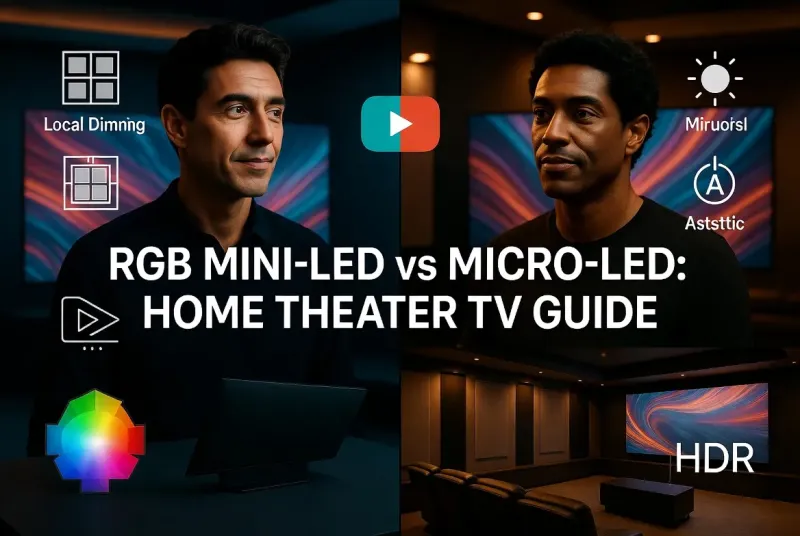
As we navigate through 2026, the home theater display landscape has reached an inflection point. Two revolutionary technologies—RGB Mini-LED and Micro-LED—are vying for dominance in the premium TV market, each offering distinct advantages that can dramatically impact your viewing experience. With prices becoming more accessible and technology maturing, the question is no longer whether to upgrade, but which technology will deliver the best cinematic experience for your specific needs and budget.
RGB Mini-LED technology has evolved significantly since its introduction, offering unprecedented brightness levels exceeding 4,000 nits, sophisticated local dimming with thousands of zones, and quantum dot color enhancement that rivals OLED's color volume. Meanwhile, Micro-LED has transitioned from laboratory curiosity to practical reality, with Samsung, LG, and Sony offering consumer-ready models that promise perfect blacks, infinite contrast, and modular designs that can scale to any size.
This comprehensive expert comparison will guide you through every aspect of choosing between RGB Mini-LED and Micro-LED TVs for your home theater in 2026. We'll examine real-world performance metrics, analyze total cost of ownership, evaluate installation requirements, and provide specific model recommendations across different price points and room sizes. Whether you're building a dedicated home theater or upgrading your living room setup, this guide will equip you with the knowledge to make an informed decision that will serve you for years to come.
Understanding the Technologies: How They Work
Before diving into comparisons, it's essential to understand the fundamental differences between these technologies and how they create images on your screen.
RGB Mini-LED Technology Explained
RGB Mini-LED represents the pinnacle of LCD evolution, combining traditional LCD architecture with advanced backlighting and color technologies:
Core Components:
- Mini-LED Backlight: Thousands of tiny LEDs (typically 200-300 micrometers) arranged in a grid behind the LCD panel, organized into hundreds or thousands of local dimming zones
- Quantum Dot Layer: Nanoparticles that convert blue LED light into pure red and green light, expanding color gamut to 95%+ of Rec. 2020
- LCD Panel: Liquid crystal layer that modulates light to create images, typically using VA (Vertical Alignment) or IPS (In-Plane Switching) technology
- Advanced Optical Films: Diffusers, prisms, and reflectors that optimize light distribution and viewing angles
How It Creates Images:
- Mini-LEDs in the backlight array illuminate in specific zones based on image content
- Local dimming algorithm independently controls brightness of each zone (from completely off to maximum brightness)
- Blue light passes through quantum dot layer, converting to red and green
- Liquid crystals twist to block or allow light through each pixel
- Color filters create final RGB image
2026 Advancements:
- Up to 10,000+ local dimming zones (vs. 1,000-2,000 in 2023)
- Peak brightness exceeding 5,000 nits for HDR content
- AI-powered local dimming with predictive algorithms
- Improved viewing angles with dual-domain VA panels
- Faster response times (1-2ms gray-to-gray)
Micro-LED Technology Explained
Micro-LED represents a fundamentally different approach, eliminating the LCD layer entirely and creating a self-emissive display:
Core Components:
- Micro-LED Arrays: Millions of microscopic LEDs (typically 50-100 micrometers), each acting as an individual red, green, or blue sub-pixel
- Active Matrix Backplane: TFT (Thin-Film Transistor) layer that individually controls each Micro-LED
- Modular Panels: Tiles that can be combined to create displays of various sizes
- Advanced Driver ICs: Integrated circuits that manage power delivery and signal processing for millions of LEDs
How It Creates Images:
- Each Micro-LED sub-pixel emits its own light (red, green, or blue)
- Individual LEDs can be turned completely off for perfect blacks
- Brightness is controlled by varying current to each LED
- No color filters or liquid crystals needed—pure RGB emission
- Modular design allows seamless scaling to any size
2026 Advancements:
- Smaller pixel pitches (0.3-0.5mm) enabling 4K at smaller sizes
- Improved manufacturing yields reducing costs by 40-60% from 2023
- Enhanced color uniformity across large panels
- Better heat dissipation enabling higher sustained brightness
- Simplified installation with magnetic mounting systems